Study Claims Contrails Contribute To Global Warming | Aero-News Network
Aero-News Network
RSS icon RSS feed
podcast icon MP3 podcast
Subscribe Aero-News e-mail Newsletter Subscribe

** AIRBORNE 06.18.13 Aero-TV-- CLICK HERE! ** HD iPad-Friendly Version -- AIRBORNE 06.18.13 **

** AIRBORNE 06.14.13 Aero-TV-- CLICK HERE! ** HD iPad-Friendly Version -- AIRBORNE 06.14.13**

** AIRBORNE 04.01.13 SPECIAL EDITION of Aero-TV-- CLICK HERE! ** HD iPad-Friendly Version -- AIRBORNE 04.01.13 SPECIAL EDITION **

Fri, Jun 16, 2006

Study Claims Contrails Contribute To Global Warming

Condensation Traps Heat In Earth's Atmosphere

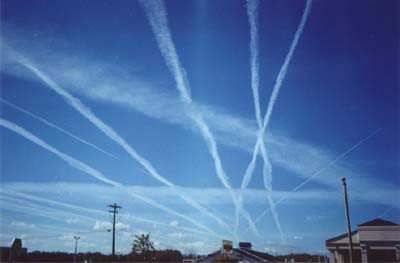
Could there be some truth to speculation -- bandied about by environmentalists for years -- that contrails from airliners could contribute to global warming?

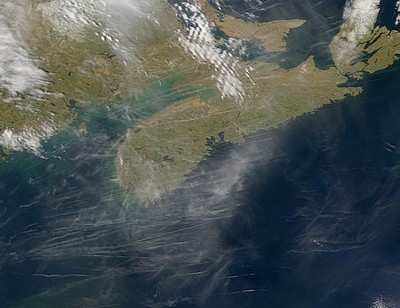
Well, the verdict is still out on that... but in a study published Thursday in the journal Nature, scientists postulate the visible streaks of condensation from high-flying airliners could contribute to the greenhouse effect, by trapping heat in the Earth's atmosphere.

University of Reading meteorologist Nicola Stuber, the first author of the study, suggests that contrails' overall impact on climate change is similar in scope to that of carbon dioxide emissions from all aircraft over a 100-year period... about 2 to 3 percent of all human CO2 emissions.

Contrails -- like other high, thin clouds -- reflect sunlight back into space and cool the planet... but the study claims they also trap energy in Earth's atmosphere and boost the warming effect.

That warming effect is particularly evident at night, Stuber said.

"The solar cooling effect [in which contrails reflect solar rays back into space] only happens during the day, when the sun is up," she explained.

The study cites Britain's airline industry, where only one in four flights is a night flight... but those flights, scientists say, create some 60 percent of the warming attributed to contrails.

"The findings have implications beyond their pure scientific value," said Stuber. "...they could be used if policy makers decided to modify flight management systems in order to reduce the climate impact of aviation."

Others scientists, however, questioned the study's findings.

"The jury is out on the impact of contrails," said Patrick Minnis, an atmospheric scientist at NASA's Langley Research Center. "Until we can measure it properly and extensively, and model it and its interaction with cirrus clouds and contrails, we will continue to have large uncertainties about the effect of contrails."

FMI: www.met.reading.ac.uk

Advertisement

More News

Progress! Great Lakes by Waco Classic Makes First Flight

First Flight 'Exceeds Expectations' It's been a long time since we could announce the first flight of a new production aircraft... but we'll take whatever progress we can find... a>[...]

Airborne 06.14.13: FAA Extorts $447K From EAA, Eurocopter's X3, TIGHAR Denials

Also: Hadfield Retires, Dornier Do 17, Chinook Contract, Boeing Forecast, Wright Memorial We can't say that this was unexpected but EAA has confirmed that it has entered, reluctant>[...]

Avidyne Reduced Cost Warranty Program May Be No Bargain -- Legally Speaking

Avidyne User Community Increasingly Vocal About Legal Concerns Over Warranty Indemnifications It was presented as a bargain to certain Avidyne avionics product owners who wanted to>[...]

Aero-News: Quote Of The Day (06.17.13)

"The aviation community can expect much more of the same... and while many events will be able to 'punt' and do what they need to do without the 'assistance' of the FAA; those even>[...]

FAA Strikes Again... Father's Day Fly-In Can't Afford FAA Temp Tower Fees

Another Sign Of The Times Casts Dark Shadow Over GA If there was ever any question as to who worked for who in terms of the FAA v The Aviation World, that time seems to have come a>[...]

blog comments powered by Disqus


Advertisement

Advertisement

Podcasts

Advertisement

© 2007 - 2013 Web Development & Design by Pauli Systems, LC