Aero-Tips!
A good pilot is always learning -- how many times have you heard
this old standard throughout your flying career? There is no truer
statement in all of flying (well, with the possible exception of
"there are no old, bold pilots.") It's part of what makes aviation
so exciting for all of us... just when you think you've seen it
all, along comes a scenario you've never imagined.

Aero-News has called upon the expertise of Thomas P. Turner,
master CFI and all-around-good-guy, to bring our readers -- and us
-- daily tips to improve our skills as aviators, and as
representatives of the flying community. Some of them, you may have
heard before... but for each of us, there will also be something we
might never have considered before, or something that didn't
"stick" the way it should have the first time we memorized it for
the practical test.
It is our unabashed goal that "Aero-Tips" will help our readers
become better, safer pilots -- as well as introducing our
ground-bound readers to the concepts and principles that keep those
strange aluminum-and-composite contraptions in the air... and allow
them to soar magnificently through it.
Look for our daily Aero-Tips segments, coming each day to you
through the Aero-News Network. Suggestions for future Aero-Tips are
always welcome, as are additions or discussion of each day's tips.
Remember... when it comes to being better pilots, we're all in this
together.
Aero-Tips 06.11.06
There's a host of things a pilot needs to review before flying
an instrument approach procedure. Once you're flying inbound
from the Final Approach fix (FAF), however, your attention should
be focused on the gauges (and scans outside for the runway
environment) until you transition to visual flight or need to climb
for the missed approach. In a single-pilot operation you do not
have the luxury of reading from the instrument approach plate as
you're inbound and converging with the ground.
Yet there are a few things you need to know in the approach
segment between the FAF and the Missed Approach Point (MAP). I
teach the mnemonic A-D-M:
A--Altitude. What is the Decision Height
(DH)/Decision Altitude (DA) or the Minimum Descent Altitude (MDA)?
Are there any stepdowns?
D--Distance. How far can I fly? What
defines the MAP (GPS, DME distance, cross radials, time). If there
are stepdowns, what defines the stepdown points?
M--What is the first portion of the Missed
Approach procedure? Do I climb straight ahead or turn? If aiming
for a NAVAID or a VOR radial, what is the approximate initial
heading? Are there altitudes that define specific actions on the
missed?
Cheating
No, I do not mean deviating from the published approach
procedure. I do propose you create a simple visual reminder of the
critical ADM items for an instrument approach—a "cheat card",
if you will—so in the inevitable instance you want to check
the information while inbound from the FAF you don't need to try to
find it on a cluttered approach plate in a dark, bumpy cockpit.
Look at the figure (below) for a typical nonprecision approach.

Inbound from the FAF you need to know:
- Altitude. Descend to 2140 MSL until RACOS
intersection, then to the MDA (1860 MSL, assuming an approach flown
at Category A speeds).
- Distance. RACOS is at 19.6 DME (from the VOR)
and the MAP is at 17.3 DME. Each may be supplemented by time
(versus groundspeed) and/or approach-certified GPS depictions.
- Missed. Climbing right turn to 3000 feet
to intercept the reciprocal of the inbound radial; approximately
110° intercept heading.
That still a lot of data. Similar to an aerobatic pilot's Aresti diagram, you might
sketch this out on a clear spot of a kneeboard. I like to use a
"sticky note" for my ADM sketch so I can stick it on the panel so
it's in my instrument scan. An example for the VOR-A approach at
KAAO might appear like this:
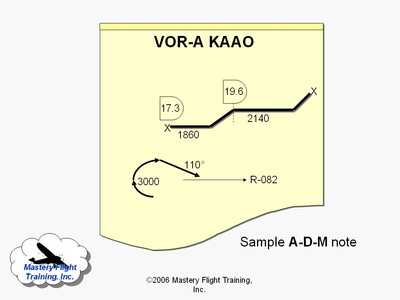
I find the process itself of making an A-D-M card helps me
memorize the vital FAF-inbound information of an instrument
approach.
Aero-tip of the day: Know A-D-M: the Altitude,
Distance and Missed information before passing the FAF inbound on
an approach.



 Airborne 04.16.24: RV Update, Affordable Flying Expo, Diamond Lil

 See All