Highly Capable Aircraft Design Continues to Rack Up A
Disproportionate Amount of Accidents
ANN has learned of yet another tragic MU-2 accident that
occurred mid-day, Friday, in an area of IFR weather, North of
Daytona Beach, FL. The second MU-2 accident in FL, in as many
months, this aircraft went down just 5 NM NW of Ormond Beach where
local conditions consisted of rain showers and areas of reduced
visibility.

The aircraft impacted in a near vertical attitude in a wooded
area near the St. Rt. 40 and St. Rd. 11. Two persons were confirmed
as having been onboard and killed on impact.
The aircraft was enroute from Bloomington, Indiana, at 0940 EST
and proceeded direct from there to the impact site at an assigned
altitude of 27,000 feet. The initial destination was listed as
Melbourne (for a reported fuel stop) though the final destination
was reported as Eleuthera, Bahamas. No radio communication has been
reported that left any evidence that the aircraft knew it had a
problem prior to the accident.
The aircraft was registered as N171MA, and was a 1980 Mitsubishi
MU-2B-40, powered by two TPE 331s. The aircraft owned by Drug and
Laboratory Disposal, Inc., of Allegan Michigan. The company is in
the hazardous waste disposal business.
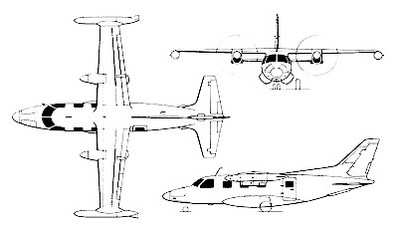
 The MU-2 series,
certified in standard category, is well-known among industry
experts and test pilots for its excellent handling characteristics
and performance criteria, is also under intense scrutiny for an
accident record that seems heavily out of proportion for the size
of the fleet. Over 80 aircraft of about 800 airframes have been
involved in fatal accidents that have killed over 250 people as of
this time.
The MU-2 series,
certified in standard category, is well-known among industry
experts and test pilots for its excellent handling characteristics
and performance criteria, is also under intense scrutiny for an
accident record that seems heavily out of proportion for the size
of the fleet. Over 80 aircraft of about 800 airframes have been
involved in fatal accidents that have killed over 250 people as of
this time.
Earlier this year, the FAA completed its third attempt to find a
cause for the accident rate by conducting an additional design
review. For the third time in the aircraft's much-maligned history,
the Mitsubishi MU-2 has received the conditional support of the
Federal Aviation Administration. The FAA once again stated that
enhanced training procedures are the answer to reducing accidents
in the speedy twin-turboprop.
The MU-2 is "a complex aircraft requiring operational techniques
not typically found in other light turboprop aircraft," the FAA
said in the safety proposal. "Fully understanding the system
complexity is much more critical during an emergency
situation."
"An MU-2B pilot is seven times more likely to lose control and
have a fatal accident during an emergency when compared to pilots
flying similar types of airplanes in similar situations," the
agency added.
"We don't believe there is a safety issue with the airplane
itself," said FAA spokesman Les Dorr Jr. "It meets its original
certification standards."
"We continue to believe that if pilots are properly trained to
fly this airplane, this airplane can be flown safely," Dorr added.
"We want to make sure the pilot training is standardized and
mandatory."
 The agency stopped
short of recommending a type-rating for the aircraft -- something
that the airplane's manufacturer has supported.
The agency stopped
short of recommending a type-rating for the aircraft -- something
that the airplane's manufacturer has supported.
A number of people have attempted to paint the aircraft as
dangerous, including one Colorado legislator who made an emotional
but factually insupportable attempt to get the aircraft restricted
or grounded. Colorado congressman Tom Tancredo insisted that the
only way to solve the MU-2's problems is to 'ground the
aircraft.'
"Additional training for pilots is helpful, but is not a
sufficient solution given the MU-2's crash statistics," Tancredo
said in a statement quoted by the Rocky Mountain News. "Grounding
the aircraft remains the optimum solution, but this is a good first
step for the FAA, who, like a recovering alcoholic, has taken the
first step of admitting that there is a problem."
ANN will keep an eye on this story and present more details as
they become available.



 ANN's Daily Aero-Term (05.07.24): Hazardous Weather Information

 See All