Airbus Steps Up Checks Of Composite Rudder Assemblies | Aero-News Network
Aero-News Network
RSS icon RSS feed
podcast icon MP3 podcast
Subscribe Aero-News e-mail Newsletter Subscribe

** AIRBORNE 06.18.13 Aero-TV-- CLICK HERE! ** HD iPad-Friendly Version -- AIRBORNE 06.18.13 **

** AIRBORNE 06.14.13 Aero-TV-- CLICK HERE! ** HD iPad-Friendly Version -- AIRBORNE 06.14.13**

** AIRBORNE 04.01.13 SPECIAL EDITION of Aero-TV-- CLICK HERE! ** HD iPad-Friendly Version -- AIRBORNE 04.01.13 SPECIAL EDITION **

Thu, Dec 20, 2007

Airbus Steps Up Checks Of Composite Rudder Assemblies

EASA Directive Applies To About 420 Aircraft

Conceding its prior recommended method to detect fatigue damage in the composite rudder assemblies of Airbus A300 and A310 aircraft may be inadequate, the European planemaker has stepped up inspections on the vertical stabilizers on about 400 of its oldest planes, as well as handful of newer A330 and A340 airliners.

The Wall Street Journal reports the stepped-up inspection program subjects the tail assemblies of the affected planes to repetitive ultrasonic and X-ray inspections, in order to find possible areas of weakness in the composite fixtures.

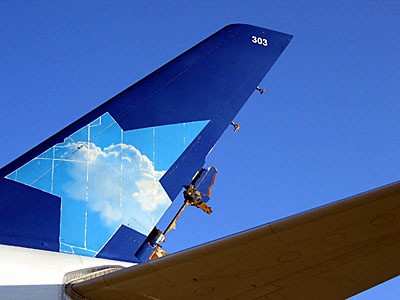
Delamination in the composite core of the rudder assembly of an Air Transat A310 led to an incident in which the aircraft lost nearly its entire vertical control surface (shown above and below) on a March 2005 flight between Cuba and Quebec. The aircraft was able to return to Cuba, with no injuries reported.

In the wake of that incident, the National Transportation Safety Board, FAA, and European Aviation Safety Agency called for immediate inspections of A300-series rudder assemblies, as well as continued inspections thereafter.

Based on recommendations by Airbus, EASA later issued a mandatory directive calling for the first such rudder checks to be completed within six months or 500 cycles, with some inspections repeated every 1,400 cycles -- on the low side for repetitive inspections of primary flight structures and control surfaces.

The high-tech methods called for to inspect the rudder assemblies are also a departure from Airbus' original inspection methods, which only required a visual once-over and a mechanic tapping on the rudder surface, to detect changes in tone that would indicate internal failure.

Airbus North America spokesman Clay McDonnell said the majority of the 400 A300s and A310s affected by the inspection schedule are flown by non-US carriers. Twenty A330 and A340 widebodies, assembled before Airbus changed its rudder-manufacturing process, are also affected.

FMI: www.airbus.com, www.easa.eu.int

Advertisement

More News

Lufthansa Firms Up Order For 100 A320 Family Aircraft

German Airline The Largest Airbus Customer And Operator In Europe The Lufthansa Group has firmed up a previous Supervisory Board decision from March this year and signed for 100 A3>[...]

Airborne 06.18.13: Reno Race Shakeup, A350 XWB First Flight, Great Lakes Flies!

Also: Beechcraft Not Happy With GAO, More Damage to GA From FAA, Cessna 172 SAIB, An Inspirational Leap The inability to reach agreement over a number of unsettled restrictions, in>[...]

FAA Requires Operation Migration Pilots To Hold Private Licenses

New Aircraft To Be Purchased With Support From Donors New airplanes will lead endangered whooping cranes from their summer range to Florida for the winter in coming years, and the >[...]

ANN's Daily Aero-Linx (06.18.13)

International Federation of Air Traffic Controllers IFATCA is a worldwide organization representing more than fifty thousand air traffic controllers in 134 countries.>[...]

ANN's Daily Aero-Term (06.18.13): One-Hundred-Hour Inspection

A complete inspection that is required for all aircraft operated for hire every 100 hours.>[...]

blog comments powered by Disqus



Advertisement

Advertisement

Podcasts

Advertisement

© 2007 - 2013 Web Development & Design by Pauli Systems, LC