

Spacesuits For The Future | Aero-News Network
Aero-News Network
RSS icon RSS feed
podcast icon MP3 podcast
Subscribe Aero-News e-mail Newsletter Subscribe

** AIRBORNE 05.21.13 Aero-TV-- CLICK HERE! ** HD iPad-Friendly Version -- AIRBORNE 05.21.13 **

** AIRBORNE 05.17.13 Aero-TV-- CLICK HERE! ** HD iPad-Friendly Version -- AIRBORNE 05.17.13 **

** AIRBORNE 04.01.13 SPECIAL EDITION of Aero-TV-- CLICK HERE! ** HD iPad-Friendly Version -- AIRBORNE 04.01.13 SPECIAL EDITION **

Mon, Mar 26, 2007

Spacesuits For The Future

High-Tech, Low Maintenance

Reminiscent of the businessman who whispered "plastics" to Dustin Hoffman in "The Graduate," a new buzzword in aeronautics may be "spacesuits."

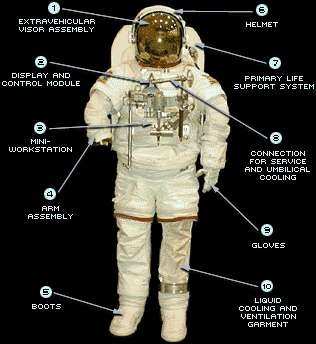
Although they aren't ready for prime time, engineers at Johnson Space Center are working on the one piece of equipment that protects and maintains the health and well-being of astronauts who may spend months at a time far above the earth's atmosphere.

This, all going on behind the scenes while all the attention focuses on NASA's new spaceship and planned missions to the moon and Mars, reports the AP.

Although it's too early in the game to know what the new suits will look like, NASA is looking for high-tech and low maintenance.

"Finding the right balance is always going to be a challenge," said veteran astronaut Jeff Williams, who has donned both the complex American suit and the spare Russian suit. "It's trade-offs."

US suits may be easier to work in for long periods of time, but their complexity means more maintenance, while the one-size-fits-all Russian suits are used a few times and thrown away, but not as easy to work in. A conundrum to be sure.

Developing new suits is certainly easier than the slide rules and drafting table used in the Apollo era; computers allow suits to be designed and re-designed before any hardware comes into play.

"There's a lot more capable tools and technology to get the job done - a lot more knowledge, as well - so we can capitalize on them," said Joe Kosmo, who was involved in the design, development, and testing of suits from the Mercury, Gemini, Apollo, Skylab and shuttle eras.

NASA's priority is to make the next spacesuit smaller and lighter - halving the 200-pound weight that Apollo astronauts carried with their suits and life support backpack.

To accomplish this, new, lightweight composite materials and smaller electronics will come into play. NASA also wants their charges to be able to move around more easily in their suits.

Terry Hill, who's developing the new spacesuit, recalled the robotic-like hops of the Apollo astronauts broadcasting from the moon, hops that every American alive at the time recalls.

"Mostly, that was because of mobility," he said. "They just didn't have it."

The new spacesuit will be usable for launch, at the space station, and on the moon and Mars. Hill envisions swapping out the top part of the suit to fit the mission's needs, a feature he hopes will save money and cargo weight, because astronauts won't have to pack several suits. Shuttle astronauts wear bright orange suits for launch and re-entry while carrying on white spacewalking suits.

Some other "must-have" features for tomorrow's space suits include the ability to withstand extreme hot and cold temperatures, to shield radiation, and to function on very low power, as the spacesuit's oxygen-rich atmosphere can quickly turn sparks into fires.

NASA plans to award a contract in a year or so, produce the first prototypes by 2010, and certify the suit by 2012 - in time for the new spaceship Orion's maiden voyage by 2014.

Hill declined to discuss the cost of the new suits because a production contract has yet to be awarded. "Nothing's cheap."

FMI: www.nasa.gov

Advertisement

More News

Update: Startling... FAA Wants EAA To Pay Them To Staff Oshkosh

Could The FAA Get ANY Stranger? Worse Yet... Will They? ANN RealTime News Update, 0001ET, 05.23.13: The FAA has twice promised ANN a statement this day in order to understand some >[...]

Classic Aero-TV: EAA’s Jack Pelton – ‘Everything’s Going to Be OK’

Building A New Future For The EAA... One Issue At A Time Originally WebCast 11.14.12: With only a couple of weeks in pocket, directing the reorganization of the EAA in the wake of >[...]

House Committee Hearing Focuses On Strategic Stepping Stones To Mars

Subcommittee Chair Call Mars Mission A Congressional Priority The House Science Committee Subcommittee on Space held a hearing Tuesday to examine possible options for the next step>[...]

Dassault Falcon Embarks On Spares Pricing Overhaul

Third Such Restructuring In 10 Years Dassault Falcon has embarked on its third parts pricing overhaul in the past 10 years, assessing the cost of over 18,500 individual items. The >[...]

ANN's Daily Aero-Linx (05.23.13)

Chandelle Chandelle is meant to be a forum for original essays, reviews, photographs, and artwork related, however loosely, to the less familiar aspects of the history of aviation.>[...]

blog comments powered by Disqus


Advertisement

Advertisement

Podcasts

Advertisement

© 2007 - 2013 Web Development & Design by Pauli Systems, LC