Thu, Aug 16, 2012
Image Taken By MRO HiRISE Camera
The first color image taken from orbit showing NASA's rover Curiosity on Mars includes details of the layered bedrock on the floor of Gale Crater that the rover is beginning to investigate.
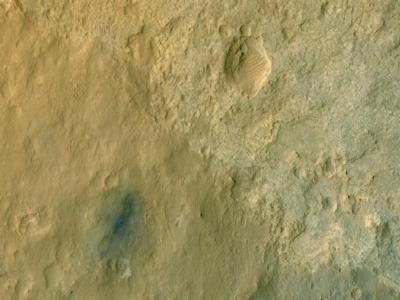
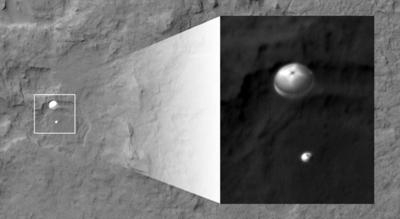
Operators of the High Resolution Imaging Science Experiment (HiRISE) camera on NASA's Mars Reconnaissance Orbiter added the color view to earlier observations of Curiosity descending on its parachute, and one day after landing.
"The rover appears as double bright spot plus shadows from this perspective, looking at its shadowed side, set in the middle of the blast pattern from the descent stage," said HiRISE Principal Investigator Alfred McEwen, of the University of Arizona, Tucson. "This image was acquired from an angle looking 30 degrees westward of straight down. We plan to get one in a few days looking more directly down, showing the rover in more detail and completing a stereo pair."
Meanwhile, Curiosity has finished a four-day process transitioning both of its redundant main computers to flight software for driving and using tools on the rover's arm. During the latter part of the Mars Science Laboratory spacecraft's 36-week flight to Mars and its complicated descent to deliver Curiosity to the Martian surface, the rover's computers used a version of flight software with many capabilities no longer needed. The new version expands capabilities for work the rover will do now that it is on Mars.
"We have successfully completed the brain transplant," said Curiosity Mission Manager Mike Watkins of NASA's Jet Propulsion Laboratory, Pasadena, Calif. "Now we are moving on to a new phase of functional checkouts of the science instruments and preparations for a short test drive."
The first drive, possibly within a week or so, will likely include short forward and reverse segments and a turn. Curiosity has a separate drive motor on each of its six wheels and steering motors on the four corner wheels. Preparation and testing of the motor controllers will precede the first drive.
After the test drive, the planning schedule has an "intermission" before a second testing phase focused on use of the rover's robotic arm. For the intermission, the 400-member science team will have the opportunity to pick a location for Curiosity to drive to before the arm-testing weeks.
"It's fair to say that the scientists, not to mention the rover drivers, are itching to move," said JPL's Ashwin Vasavada, deputy project scientist for Curiosity.
Researchers have been examining images from Curiosity's cameras and HiRISE to identify potential targets to investigate near the rover and on the visible slope of the nearby three-mile-high mound informally named Mount Sharp. "The science and operations teams are evaluating several potential routes that would take us to Mount Sharp, with perhaps a few waypoints to inspect some of the different terrains we've identified as we map the landing area," Vasavada said. "As we have reported many times before, it's going to take us a good part of our first year to make it to the layered sediments on Mount Sharp."
During a prime mission of nearly two years, researchers will use Curiosity to investigate whether the selected area of Mars has ever offered chemical ingredients for life and other environmental conditions favorable for supporting microbial life. Curiosity carries 10 science instruments with a total mass 15 times as large as the science payloads on NASA's Mars rovers Spirit and Opportunity. To handle this science toolkit, Curiosity is twice as long and five times as heavy as Spirit or Opportunity. The landing site inside Gale Crater places the rover within driving distance of layers of Mount Sharp. Observations from orbit have identified clay and sulfate minerals in the lower layers, indicating a wet history.
(Photos courtesy NASA)
More News
Also: B-29 Superfortress Reunion, FAA Wants Controllers, Spirit Airlines Pulls Back, Gogo Galileo Van's Aircraft posted a short video recapping the goings-on around their reorganiz>[...]
Light Gun A handheld directional light signaling device which emits a brilliant narrow beam of white, green, or red light as selected by the tower controller. The color and type of>[...]
"The journey to this achievement started nearly a decade ago when a freshly commissioned Gentry, driven by a fascination with new technologies and a desire to contribute significan>[...]
"Our driven and innovative team of military and civilian Airmen delivers combat power daily, ensuring our nation is ready today and tomorrow." Source: General Duke Richardson, AFMC>[...]
Aircraft Conflict Predicted conflict, within EDST of two aircraft, or between aircraft and airspace. A Red alert is used for conflicts when the predicted minimum separation is 5 na>[...]



 Airborne 04.16.24: RV Update, Affordable Flying Expo, Diamond Lil
 See All