Mon, May 14, 2012
Pilot On Board For First Flight, Will Eventually Be Unmanned
The U.S. Air Force completed the first manned flight of the QF-16 Full Scale Aerial Target (FSAT) on May 4 at Cecil Field in Jacksonville, FL. The QF-16 took off at 1505 EDT. Eastern time and climbed to an altitude of 41,000 feet during its 66-minute flight. The Air Force awarded a multi-year contract to Boeing in March 2010 that represented Phase I of the initial engineering, manufacturing and development of the QF-16, with options to buy up to 126 FSATs.
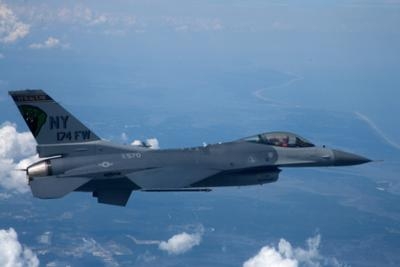
"With this successful first flight of the QF-16, the Air Force, Boeing and our supplier-partners have laid the groundwork for the program to enter low-rate production in 2013 and make its first production delivery in 2014," said Torbjorn Sjogren, Boeing vice president, Global Maintenance and Upgrades.
The functional check flight of the F-16, under control of a Boeing test pilot, validated the basic aircraft performance with the QF-16 drone modification package installed. The additional hardware Boeing installs allows the QF-16 to fly in an unmanned mode while under the control sof a ground-based control system such as the Gulf Range Drone Control System (GRDCS) at Tyndall Air Force Base, FL, or the Drone Formation Control System (DFCS) at White Sands Missile Range (WSMR), NM. During the current test phase in Jacksonville, a GRDCS mobile trailer with portable transmission towers provides communications between the flight controller and other personnel on the ground and the QF-16 pilot.
"This was a tremendous milestone for the program and for Boeing because it signals our continued success as an off-Boeing platform support and sustainment provider," said Bob Insinna, Boeing QF-16 program manager.
The QF-16s will be a higher-performing aircraft than the QF-4 they replace and representative of fourth-generation targets. They will be flown manned or unmanned within a controlled range and equipped to evaluate how U.S. fighters and weapons will operate against potential adversaries. Boeing will deliver six QF-16 test aircraft to Tyndall in October for additional testing over the Gulf Range. Following the successful conclusion of these tests, Boeing will support government flight testing from Holloman Air Force Base, NM, over the WSMR complex.
More News
Aero Linx: JAARS Nearly 1.5 billion people, using more than 5,500 languages, do not have a full Bible in their first language. Many of these people live in the most remote parts of>[...]
'Airplane Bounced Twice On The Grass Runway, Resulting In The Nose Wheel Separating From The Airplane...' Analysis: The pilot reported, “upon touchdown, the plane jumped back>[...]
"Burt is best known to the public for his historic designs of SpaceShipOne, Voyager, and GlobalFlyer, but for EAA members and aviation aficionados, his unique concepts began more t>[...]
"Polaris Dawn, the first of the program’s three human spaceflight missions, is targeted to launch to orbit no earlier than summer 2024. During the five-day mission, the crew >[...]
There Are SO Many Ways To Get YOUR Aero-News! It’s been a while since we have reminded everyone about all the ways we offer your daily dose of aviation news on-the-go...so he>[...]



 ANN's Daily Aero-Linx (05.04.24)


 See All