Will Be Used As VERY Realistic Flight Sim
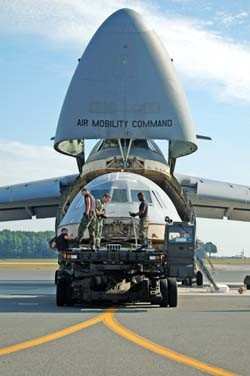 The crew compartment
belonging to the C-5 Galaxy aircraft that fell less than a mile short of the
runway at Dover Air Force Base April 3 has been
salvaged for use in C-5 aircraft crew training.
The crew compartment
belonging to the C-5 Galaxy aircraft that fell less than a mile short of the
runway at Dover Air Force Base April 3 has been
salvaged for use in C-5 aircraft crew training.
The aircraft's flight deck was loaded onto a C-5 and airlifted
to its new home August 22 at Robins Air Force Base, GA where it
will be used as a modernized C-5 software simulator, according to
Chief Master Sgt. Jon Lynn, the 436th Maintenance Squadron
superintendent and supervisor of the mishap recovery effort.
"This was the first-ever C-5 flight deck transported (as cargo)
via airplane," said Senior Master Sgt. Stephen Martin, the 436th
Aerial Port Squadron air freight superintendent who oversaw a crew
of specialists transporting the flight deck from the mishap scene
to the plane.
Flight decks are assembled and installed at Lockheed Martin's
C-5 Galaxy production facility in Marietta, GA... so there is
usually no need to transport them via aircraft as they are normally
attached to the fuselage.
Various members from Dover, along with experts from Robins AFB
and civilian engineers, worked together to prepare the compartment
for its departure from Dover.
The crew compartment was recovered in May, using power saws to
separate it from the fuselage and a crane to lift it.
"Once we had the flight deck off of the fuselage, we stored it
on one of (the 436th Logistics Readiness Squadron's) flatbed
trailers," said Chief Lynn. "The removal process left many
dangerous, sharp corners and cuts. We trimmed up the flight deck to
reduce the hazards around it and make it shippable."
Once the compartment was transportable, it was hauled from the
mishap site, stored and finally prepped for airlift.
It took six Airmen to successfully load the 15,000-pound flight
deck onto a C-5 for shipment. Due to the unusual shape and size of
the flight deck, it had special loading requirements and
transporting procedures.
"When moving a larger piece of equipment like this one, which is
going to be uploaded onto a C-5 by a K-loader, a unique procedure
that needs to be done is configuring the loader so the piece will
fit," said Senior Airman Joseph Mosley, a 436th APS ramp service
member and crew chief for the uploading. Spotters and vehicle
drivers were used for extra safety precautions.
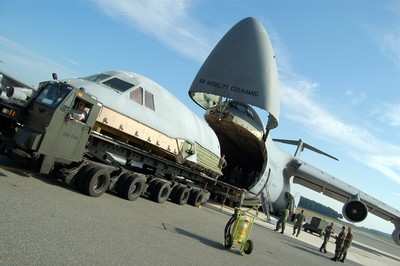
The side rails on the aircraft tunner loader -- a large, flatbed
vehicle used for loading cargo -- were removed to enable the flight
deck to fit. Then, the load team pushed the cargo from the loader
onto the plane, while spotters ensured the safety of the
operation.
Once the compartment was loaded, it was flown and delivered to
the depot at Robins AFB, where it will be repaired and modified to
perform its new functions.
"The role the flight deck will play in the future is
invaluable," Chief Lynn said. "We are effectively taking a mishap
aircraft and using it to prevent future mishaps."
At Robins, the recycled crew compartment will be used to
contribute for training and the testing of aircrews.
"Simulators play an absolutely critical role for not only
pilots, but also flight engineers and loadmasters," said Capt.
Chris Knier, the 436th Operations Support Squadron pilot training
manager. "They are a resource (for) annual refresher training in a
controlled environment to set up scenarios (and) exercise specific
skill sets."
Along with all 17 passengers and crew members on board during
the mishap, the crew compartment can be considered a survivor; one
that can help prevent future accidents like the one it and its
passengers endured in April.
"It's good to know that the people who will use this simulator
will realize the importance of the lessons they're learning,
because they can learn how to prevent similar accidents in a device
that is a result of one," the captain said.
(Aero-News salutes Staff Sgt. James Wilkinson, 436th Airlift
Wing Public Affairs)



 Airbus Racer Helicopter Demonstrator First Flight Part of Clean Sky 2 Initiative
 See All