

Daring Aerial Rescue Saves Russian Researchers | Aero-News Network
Aero-News Network
RSS icon RSS feed
podcast icon MP3 podcast
Subscribe Aero-News e-mail Newsletter Subscribe

** AIRBORNE 05.21.13 Aero-TV-- CLICK HERE! ** HD iPad-Friendly Version -- AIRBORNE 05.21.13 **

** AIRBORNE 05.17.13 Aero-TV-- CLICK HERE! ** HD iPad-Friendly Version -- AIRBORNE 05.17.13 **

** AIRBORNE 04.01.13 SPECIAL EDITION of Aero-TV-- CLICK HERE! ** HD iPad-Friendly Version -- AIRBORNE 04.01.13 SPECIAL EDITION **

Mon, Mar 08, 2004

Daring Aerial Rescue Saves Russian Researchers

Ice Station Melted Beneath Them -- Helos To The Rescue

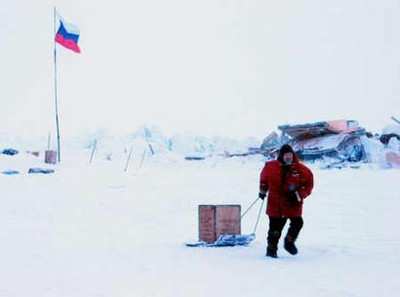
Perhaps we didn't hear much about it, but all of Russia has been riveted on the fate of an Arctic exploration team after the ocean swallowed up 90 percent of their research station last week. Now, the team is home safe, thanks to a daring aerial rescue.

"We knew we would be rescued in time," said Vladimir Kochelev, the head of the first permanent Russia ice flow station in the Arctic since the Soviet Union broke up in 1991. Neither Kochelev nor his 12 fellow researchers was injured in the nail-biting episode.

Most of North Pole-32 sank into the frigid waters after the ice beneath the research facility suddenly melted Wednesday night. Kochelev and his team said the station virtually disappeared beneath the waves in less than a half-hour.

The only hope to reach the stranded scientists was by air. So Russia launched an Mi-26 helicopter to the top of the world, not sure if the rescue attempt would succeed.

"The place is at our maximum flying range, devoid of reference points and completely white. But the main thing is to find the people. One must bear in mind that no one has done anything of this kind before," Igor Lavrenyuk, deputy commander of the local aviation squadron, told state television.

The helicopter did navigate its way to the beleaguered scientists, but its crew was unsure if it would be able to land. The crew brought along rope ladders, just in case, but they proved unneeded. The helo was able to land on the ice and the scientists, who ironically were researching climate change, were able to scramble on board.

FMI: www.aari.nw.ru

Advertisement

More News

Four Companies Recognized With 2013 EBAA Safety Of Flight Awards

Cited For Focus On Maintaining And Improving Best Practices Four European companies have been recognized for their commitment to safe operations as recipients of the 2013 European >[...]

Classic Aero-TV: Viking Engines--Building A Rep For Alternative SportAv Engines

Rotax Is NOT The Only Player In Sport Aviation Propulsion Ya gotta hand to Viking... in an industry so VERY well dominated by Rotax, it takes some serious talent and extraordinary >[...]

ANN's Daily Aero-Linx (05.22.13)

The European Cockpit Association The European Cockpit Association (ECA) was created in 1991 and is the representative body of European pilots at European Union (EU) level. It repre>[...]

ANN's Daily Aero-Term (05.22.13): Known Traffic

With respect to ATC clearances, means aircraft whose altitude, position, and intentions are known to ATC.>[...]

Aero-News: Quote Of The Day (05.22.13)

"(T)he PC-24 is a completely new development – not a 'me too product'." Source: Oscar J. Schwenk, Chairman of the Board of Directors of Pilatus, introducing the company's new>[...]

blog comments powered by Disqus



Advertisement

Advertisement

Podcasts

Advertisement

© 2007 - 2013 Web Development & Design by Pauli Systems, LC