Sat, Jul 25, 2009
They're Learning How Aviation Is Used In Environmental
Research
 Twenty-nine undergraduate and graduate students are
participating in a six-week NASA Airborne Science field experience
designed to immerse them in NASA's Earth Science research. The
students represent 26 colleges and universities across the U.S. and
nine foreign countries.
Twenty-nine undergraduate and graduate students are
participating in a six-week NASA Airborne Science field experience
designed to immerse them in NASA's Earth Science research. The
students represent 26 colleges and universities across the U.S. and
nine foreign countries.
NASA's Student Airborne Research program runs from July 6 to
Aug. 14 in California. The program began with lectures from
university faculty members, research institutions and NASA
scientists at the University of California, Irvine. One of the
speakers is Sherwood Rowland of the University of California,
Irvine, a Nobel Laureate in chemistry, who is a long-time user of
NASA's DC-8 airborne capabilities for his research on atmospheric
chemistry.
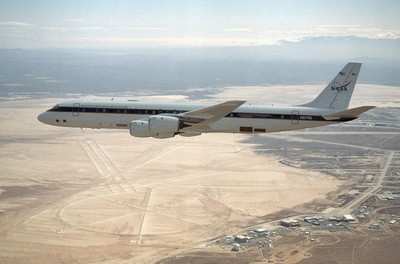
Using the DC-8 flying laboratory based at NASA's Dryden Aircraft
Operations Facility in Palmdale, CA, the students will get a rare
behind-the-scenes look at instrument integration, flight planning
and payload testing that is the basis of every successful Earth
Science airborne campaign carried out by NASA. These airborne
research campaigns play a pivotal role in the calibration and
validation of NASA's space-borne Earth observations, remote sensing
measurements and the high-resolution imagery for Earth system
science.

Divided into the investigative groups of atmospheric science,
algal blooms and crop classification, students will have the
opportunity to fly aboard one of two six-hour DC-8 flights
departing from NASA's Palmdale facility. The aircraft will travel
north over the San Joaquin Valley for an air-quality investigation,
over the Sacramento-San Joaquin River Delta to observe vegetation,
and south over Monterey Bay to research algae blooms.
The student program is one of NASA's tools for training future
scientists for Earth Science missions that can assist with studies
and the development and testing of new instruments and future
satellite mission concepts. The program's goal is to stimulate
interest in NASA's Earth Science research and aid in recruitment of
the next generation of engineers and scientists. Through this and
the agency's other college and university programs, NASA is
developing critical skills and capabilities needed for the agency's
engineering, scientific and technical missions.
The Student Airborne Research Program is managed through the
National Suborbital Education and Research Center at the University
of North Dakota, with funding and support from NASA's Airborne
Science Program. The center was established through a cooperative
agreement between the University of North Dakota and NASA.
More News
Airbus Racer Demonstrator Makes Inaugural Flight Airbus Helicopters' ambitious Racer demonstrator has achieved its inaugural flight as part of the Clean Sky 2 initiative, a corners>[...]
A little Bit Quieter, Said Testers, But in the End it's Still a DA40 Diamond Aircraft recently completed a little pilot project with Lufthansa Aviation Training, putting a pair of >[...]
Line Up And Wait (LUAW) Used by ATC to inform a pilot to taxi onto the departure runway to line up and wait. It is not authorization for takeoff. It is used when takeoff clearance >[...]
Contributing To The Accident Was The Pilot’s Use Of Methamphetamine... Analysis: The pilot departed on a local flight to perform low-altitude maneuvers in a nearby desert val>[...]
From 2015 (YouTube Version): Overcoming Obstacles To Achieve Their Dreams… At EAA AirVenture 2015, FedEx arrived with one of their Airbus freight-hauling aircraft and placed>[...]



 Airbus Racer Helicopter Demonstrator First Flight Part of Clean Sky 2 Initiative
 See All