Tue, Aug 11, 2009
First Pressurized Airplane Produced By The company Was
Certified 30 Years Ago
As part of the Embraer’s 40th anniversary commemorations,
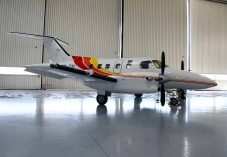
the company performed a careful restoration of the EMB 121 Xingu
prototype, tail number PP-ZXI, which was the first pressurized
airplane built by Embraer. The restoration work was carried out by
students from the National Industrial Apprenticeship Service
(Serviço Nacional de Aprendizagem Industrial – SENAI)
in São José dos Campos, Jacareí, and
Taubaté, under the supervision of Embraer personnel. After
being displayed for Company employees, the aircraft will be on
permanent exhibit at the Aerospace Museum (MUSAL), in Rio de
Janeiro.

In 2009, the EMB 121 Xingu, of which 105 were built, celebrates
the 30th anniversary of its certification. This initiative
continues the process of restoring Embraer aircraft that began in
2008 with the second prototype of the Bandeirante. The airplane was
originally designed and built by the then-Aeronautical Technical
Center (Centro Técnico de Aeronáutica – CTA),
now the Aerospace Technology General Command, leading to the
founding of Embraer, on August 19, 1969. The same work was done on
both prototypes of the CBA 123, in 2009. “It has been a
unique opportunity to be able to restore Embraer’s historic
aircraft,” explains Pedro Ferraz, Director of the Embraer
Education and Research Institute. “The Xingu PP-ZXI flew for
the first time on October 22, 1976, and is different from the other
models that were manufactured. Following its validation, the cabin
of this airplane as lengthened, in order to accommodate more
passengers, and received more powerful engines. However, this
version was never produced in series.” Coordinated by
technical leaders from Embraer, the students from SENAI dedicated
themselves to the project simultaneously to their academic
studies.
The activities involved instruction, training, and oversight of
the students who acquired knowledge regarding aircraft
manufacturing, assembly techniques, and the use of
specialized tools. During the restoration process, several parts of
the fuselage, cabin, and wings needed to be rebuilt with composite
materials.
More News
Touchdown Zone Lighting Two rows of transverse light bars located symmetrically about the runway centerline normally at 100 foot intervals. The basic system extends 3,000 feet alon>[...]
“Discovery and innovation are central to our mission at Virgin Galactic. We’re excited to build on our successful record of facilitating scientific experiments in subor>[...]
"We are reaching out to you today on behalf of the Popular Rotorcraft Association because we need your help. We are dangerously close to losing a critical resource that if lost, wi>[...]
UAS Traffic Management (UTM) The unmanned aircraft traffic management ecosystem that will allow multiple low altitude BVLOS operations and which is separate from, but complementary>[...]
Aero Linx: Society of Aviation and Flight Educators (SAFE) SAFE is a member-oriented organization of aviation educators fostering professionalism and excellence in aviation through>[...]



 ANN's Daily Aero-Term (05.02.24): Touchdown Zone Lighting
 See All