Tue, Jun 05, 2012
HALE Aircraft Is Designed To Remain Airborne For Up To 4 Days While Reaching Altitudes Of 65,000 Feet
Boeing's Phantom Eye unmanned airborne system (UAS) completed its first autonomous flight June 1 at NASA's Dryden Flight Research Center at Edwards Air Force Base, CA. The 28-minute flight began at 0622 PDT time as the liquid-hydrogen powered aircraft lifted off its launch cart. Phantom Eye climbed to an altitude of 4,080 feet and reached a cruising speed of 62 knots. After touching down, the vehicle sustained some damage when the landing gear dug into the lakebed and broke.
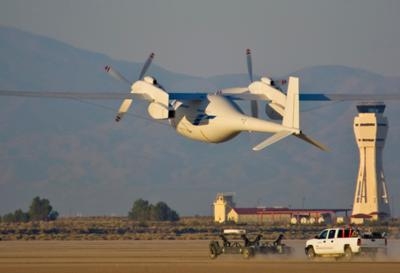
"This day ushers in a new era of persistent Intelligence, Surveillance and Reconnaissance (ISR) where an unmanned aircraft will remain on station for days at a time providing critical information and services," said Darryl Davis, president, Boeing Phantom Works. "This flight puts Boeing on a path to accomplish another aerospace first -- the capability of four days of unrefueled, autonomous flight."
Phantom Eye is the latest in a series of Boeing-funded rapid prototyping programs, which include Phantom Ray, Echo Ranger, ScanEagle Compressed Carriage, and an associated Common Open Mission Management Command and Control (COMC2) system capable of managing all of the company's unmanned assets. "While Phantom Eye is important for many reasons, future ISR, strike and bomber programs also will benefit from the technologies we are developing and maturing for our customers," said Davis.
The flight took place following a series of taxi tests in April that validated ground guidance, navigation and control, mission planning, pilot interface and operational procedures. "This flight demonstrated Phantom Eye's initial handling and maneuverability capabilities," said Phantom Eye Program Manager Drew Mallow. "The team is now analyzing data from the mission and preparing for our next flight. When we fly the demonstrator again, we will enter higher and more demanding envelopes of high-altitude flight."
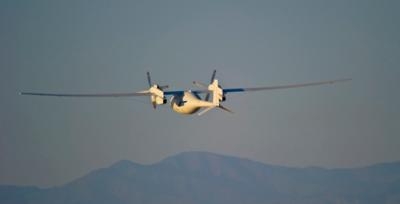
Phantom Eye's innovative and environmentally responsible liquid-hydrogen propulsion system will allow the aircraft to stay on station for up to four days while providing persistent monitoring over large areas at a ceiling of up to 65,000 feet, creating only water as a byproduct. The demonstrator, with its 150-foot wingspan, is capable of carrying a 450-pound payload. The company's portfolio of UAS solutions includes the A160T Hummingbird, H-6U Unmanned Little Bird, S-100 Camcopter, Integrator, ScanEagle (which is currently in service in Canada, Australia, Poland, the Netherlands and Malaysia), Dominator, Phantom Eye and Phantom Ray.
More News
Also: B-29 Superfortress Reunion, FAA Wants Controllers, Spirit Airlines Pulls Back, Gogo Galileo Van's Aircraft posted a short video recapping the goings-on around their reorganiz>[...]
Light Gun A handheld directional light signaling device which emits a brilliant narrow beam of white, green, or red light as selected by the tower controller. The color and type of>[...]
"The journey to this achievement started nearly a decade ago when a freshly commissioned Gentry, driven by a fascination with new technologies and a desire to contribute significan>[...]
"Our driven and innovative team of military and civilian Airmen delivers combat power daily, ensuring our nation is ready today and tomorrow." Source: General Duke Richardson, AFMC>[...]
Aircraft Conflict Predicted conflict, within EDST of two aircraft, or between aircraft and airspace. A Red alert is used for conflicts when the predicted minimum separation is 5 na>[...]



 Airborne 04.16.24: RV Update, Affordable Flying Expo, Diamond Lil
 See All