
Curiosity Beams Back First 360-Degree Panorama Of Gale Crater | Aero-News Network
Aero-News Network
RSS icon RSS feed
podcast icon MP3 podcast
Subscribe Aero-News e-mail Newsletter Subscribe

** AIRBORNE 05.21.13 Aero-TV-- CLICK HERE! ** HD iPad-Friendly Version -- AIRBORNE 05.21.13 **

** AIRBORNE 05.17.13 Aero-TV-- CLICK HERE! ** HD iPad-Friendly Version -- AIRBORNE 05.17.13 **

** AIRBORNE 04.01.13 SPECIAL EDITION of Aero-TV-- CLICK HERE! ** HD iPad-Friendly Version -- AIRBORNE 04.01.13 SPECIAL EDITION **

Fri, Aug 10, 2012

Curiosity Beams Back First 360-Degree Panorama Of Gale Crater

Rocket-Assisted Descent Exposed Martian Bedrock

Remarkable image sets from NASA's Curiosity rover and Mars Reconnaissance Orbiter (MRO) are continuing to develop the story of Curiosity's landing and first days on Mars.

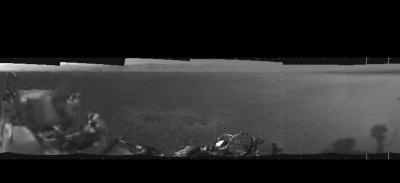
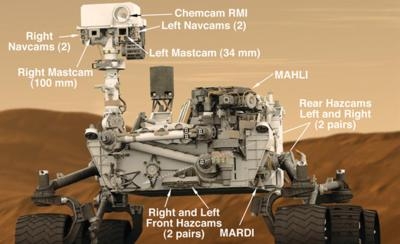
The images from Curiosity's just-activated navigation cameras, or Navcams, include the rover's first self-portrait, looking down at its deck from above. Another Navcam image set, in lower-resolution thumbnails, is the first 360-degree view of Curiosity's new home in Gale Crater. Also downlinked were two, higher-resolution Navcams providing the most detailed depiction to date of the surface adjacent to the rover.

"These Navcam images indicate that our powered descent stage did more than give us a great ride, it gave our science team an amazing freebie," said John Grotzinger, project scientist for the mission from the California Institute of Technology in Pasadena. "The thrust from the rockets actually dug a one-and-a-half-foot-long [0.5 meter] trench in the surface. It appears we can see Martian bedrock on the bottom. Its depth below the surface is valuable data we can use going forward." 

Another image set, courtesy of the Context Camera, or CTX, aboard NASA's MRO has pinpointed the final resting spots of the six, 55-pound (25-kilogram) entry ballast masses. The tungsten masses impacted the Martian surface at a high speed of about 7.5 miles (12 kilometers) from Curiosity's landing location.

Wednesday, the team deployed the 3.6 foot-tall camera mast, activated and gathered surface radiation data from the rover's Radiation Assessment Detector and concluded testing of the rover's high-gain antenna. Curiosity carries 10 science instruments with a total mass 15 times as large as the science payloads on NASA's Mars rovers Spirit and Opportunity. Some of the tools, such as a laser-firing instrument for checking rocks' elemental composition from a distance, are the first of their kind on Mars. Curiosity will use a drill and scoop, which are located at the end of its robotic arm, to gather soil and powdered samples of rock interiors, then sieve and parcel out these samples into the rover's analytical laboratory instruments.

To handle this science toolkit, Curiosity is twice as long and five times as heavy as Spirit or Opportunity. The Gale Crater landing site places the rover within driving distance of layers of the crater's interior mountain. Observations from orbit have identified clay and sulfate minerals in the lower layers, indicating a wet history.

(Images provided by NASA)

FMI: www.nasa.gov/mars

Advertisement

More News

X-47B Accomplishes Its First Ever Carrier Touch And Go

Maneuver Performed Aboard CVN 77 The Navy's X-47B Unmanned Combat Air System Demonstrator (UCAS-D) began touch and go landing operations aboard the aircraft carrier USS George H.W.>[...]

Honeywell's New HTF7350 Engine To Power Bombardier Challenger 350

HTF7000 Series Surpasses 1.5 Million Flight Hours With Better Than 99 Percent Dispatch Reliability Honeywell has announced that its HTF7350, the latest engine to join its successfu>[...]

Airborne 05.21.13: Cirrus Chute Fails, NASA Record, More NIMBY Nonsense

Also: PC-12 Record, Maule Nation, Cockpit Lockout, 34,000 Airliners Needed, Beechcraft Wins Big Contract You know you're having a bad day when a flight goes so bad that you feel yo>[...]

Helo Crew Missing From Vietnam War Accounted For, Interred At Arlington

Four Buried As A Group May 2 A Navy Pilot, missing from the Vietnam War, has been accounted-for and was buried with full military honors along with his crew. According to the Depar>[...]

ANN's Daily Aero-Linx (05.21.13)

Forest Service Smoke Jumpers Smokejumping was first proposed in 1934 by T.V. Pearson, the Forest Service Intermountain Regional Forester, as a means to quickly provide initial atta>[...]

blog comments powered by Disqus


Advertisement

Advertisement

Podcasts

Advertisement

© 2007 - 2013 Web Development & Design by Pauli Systems, LC