
NASA Confirms Something 'Dinged' Atlantis On Last Mission | Aero-News Network
Aero-News Network
RSS icon RSS feed
podcast icon MP3 podcast
Subscribe Aero-News e-mail Newsletter Subscribe

Airborne Unlimited -- Most Recent Daily Episodes

Episode Date

Airborne-Monday

Airborne-Tuesday

Airborne-Wednesday Airborne-Thursday

Airborne-Friday

Airborne On YouTube

Airborne-Unlimited-12.08.25

AirborneNextGen-
12.09.25

Airborne-Unlimited-12.10.25

Airborne-AffordableFlyers-12.11.25

AirborneUnlimited-12.12.25

AFE 2025 LIVE MOSAIC Town Hall (Archived): www.airborne-live.net

Fri, Oct 06, 2006

NASA Confirms Something 'Dinged' Atlantis On Last Mission

Agency Doesn't Know What Caused Damage To Radiator Panel

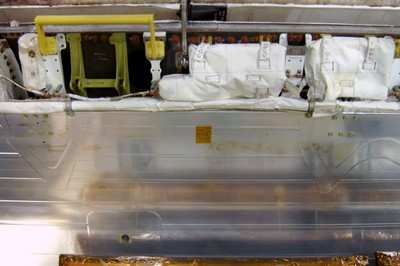
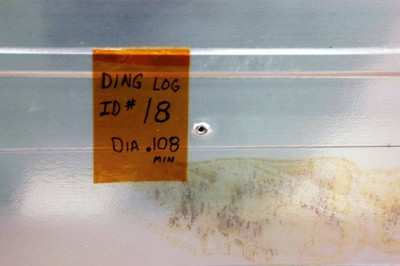
Did the space shuttle Atlantis take a ding during its recent mission to the International Space Station? Experts outside of NASA reported Wednesday they thought so... and late Thursday afteroon, NASA confirmed reports the agency is studying a dent, one-tenth of an inch deep, it refers to as Ding 18.

The crater was found in one of the shuttle's two thermal radiators. The radiators fold out of the cargo bay to shed excess heat from the cabin. They aren't exposed during launch and reentry... so the damage occurred while the shuttle was in orbit.

Internal NASA documents refer to the ding as the first or second largest hit in the shuttle's history. The document also notes that had whatever dinged the thermal panel hit an RCC -- or reinforced carbon-carbon panel, which make up the shuttle's outer skin -- it would've made more than a dent; it might even have made a hole.

It was a hole in the shuttle Columbia's leading edge RCC that led to its breakup on reentry in 2003. NASA has determined that damage likely came as foam shedding off the fuel tank during launch impacted the panel.

"The nature of the object that hit the shuttle radiator isn’t known," NASA acknowledged on its website.

A micrometeoroid, or a small piece of floating debris, are seen as possible culprits.

Scientists also don't know if the damage is related to the small pieces of debris shuttle astronauts saw around the orbiter towards the end of the mission.

Atlantis was never in any danger on its recent mission. An on-orbit shuttle inspection program NASA instituted after the Columbia tragedy would likely have found any damage to critical components.

Had the thermal radiator been destroyed, NASA would have just cut the mission short -- de-orbiting the shuttle within 24 hours after the radiator's failure.

FMI: www.nasa.gov/shuttle

Advertisement

More News

ANN FAQ: Contributing To Aero-TV

How To Get A Story On Aero-TV News/Feature Programming How do I submit a story idea or lead to Aero-TV? If you would like to submit a story idea or lead, please contact Jim Campbel>[...]

Aero-News: Quote of the Day (12.10.25)

“As the excitement builds for the world of flight returning to Oshkosh in 2026, we wanted to ensure that advance tickets are available for those who enjoy giving AirVenture t>[...]

ANN's Daily Aero-Term (12.10.25): North Atlantic High Level Airspace (NAT HLA)

North Atlantic High Level Airspace (NAT HLA) That volume of airspace (as defined in ICAO Document 7030) between FL 285 and FL 420 within the Oceanic Control Areas of Bodo Oceanic, >[...]

Airborne 12.08.25: Samaritan’s Purse Hijack, FAA Med Relief, China Rocket Fail

Also: Cosmonaut Kicked Out, Airbus Scales Back, AF Silver Star, Russian A-60 Clobbered A Samaritan’s Purse humanitarian flight was hijacked on Tuesday, December 2, while atte>[...]

Airborne-Flight Training 12.04.25: Ldg Fee Danger, Av Mental Health, PC-7 MKX

Also: IAE Acquires Diamond Trainers, Army Drones, FedEx Pilots Warning, DA62 MPP To Dresden Tech Uni The danger to the flight training industry and our future pilots is clear. Dona>[...]

blog comments powered by Disqus



Advertisement

Advertisement

Podcasts

Advertisement

© 2007 - 2025 Web Development & Design by Pauli Systems, LC

