 Two residents of the
International Space Station ventured outside the complex Wednesday
for a 5 hour, 38 minute spacewalk to reposition, deploy and
relocate equipment, and to take a swing at a commercially sponsored
activity.
Two residents of the
International Space Station ventured outside the complex Wednesday
for a 5 hour, 38 minute spacewalk to reposition, deploy and
relocate equipment, and to take a swing at a commercially sponsored
activity.
With Flight Engineer Thomas Reiter inside to monitor systems,
Expedition 14 Commander Mike Lopez-Alegria and Flight Engineer
Mikhail Tyurin opened the hatch to the Pirs Docking Compartment
airlock at 6:17 p.m. CST as the station flew over the Atlantic
Ocean near the west coast of Africa. They wore Russian Orlan
spacesuits for the 19th spacewalk conducted out of Pirs since it
was mated to the Russian segment of the station in September 2001
during Tyurin's first flight as part of Expedition 3.
The start of the spacewalk was delayed more than an hour after
Tyurin encountered a problem with a cooling hose for his spacesuit.
He climbed out the suit to reposition the hose, and uninterrupted
cooling for the suit was restored.
After setting up tools and equipment outside Pirs, Tyurin placed
a three- gram golf ball on a spring-mounted tee and clamped it onto
the ladder next to the Pirs hatch. Appearing uncomfortable with his
feet planted on the ladder, Tyurin used a gold-plated six-iron to
tap the golf ball safely away from the aft end of the Zvezda
Service Module. Tyurin said he was pleased with his golf shot, and
Russian flight controllers chose not to have him hit another ball
so the crew could tackle other tasks.
 Tyurin's golf shot was part of a
demonstration for a commercially sponsored endeavor between a
Canadian golf company and the Russian Federal Space Agency. The
golf club and three balls were flown to the station on recent
Russian Progress cargo ships. NASA's safety analysis showed that
the balls will re-enter the Earth's atmosphere and burn up in about
three days. The balls weigh only about as much as three one-dollar
bills.
Tyurin's golf shot was part of a
demonstration for a commercially sponsored endeavor between a
Canadian golf company and the Russian Federal Space Agency. The
golf club and three balls were flown to the station on recent
Russian Progress cargo ships. NASA's safety analysis showed that
the balls will re-enter the Earth's atmosphere and burn up in about
three days. The balls weigh only about as much as three one-dollar
bills.
The two spacewalkers then moved to the end of Zvezda where the
recently arrived ISS Progress 23 cargo ship is docked. Tyurin
released a latch on one of the antennas for the craft's Kurs
automated rendezvous system that failed to retract when the
Progress docked on Oct. 26. Tyurin and Lopez-Alegria attempted to
move the so-called "orientation" antenna back to its retracted and
stowed position with their hands and with a prybar, but the antenna
would not budge. Russian flight controllers also sent commands to
drive the antenna to its retracted position, but that also
failed.
The spacewalkers took a number of pictures to send to Russian
engineers, who will evaluate options for freeing the stuck antenna
on a future spacewalk. The engineers surmise something may be
frozen in the linkage for the antenna's drive mechanism, preventing
it from moving.
While at the aft of Zvezda, Tyurin and Lopez-Alegria spent a few
minutes removing and repositioning one of several communications
antennas previously installed around the module's docking port.
This will assist the docking of the European Automated Transfer
Vehicle that will be launched on an Ariane 5 rocket from Kourou,
French Guiana next year.
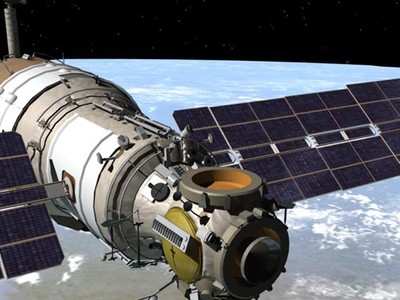
In its previous location, the antenna partially blocked the
opening of one of Zvezda's engine covers. The antenna was
reinstalled less than a foot from its original position, out of the
way of future operations with the engine.
Next, Lopez-Alegria and Tyurin moved to the top of the forward
section of Zvezda to install an experiment called "BTN-Neutron"
that will measure the volume of neutron particles emitted by solar
flares that reach low Earth orbit. The crew wrapped up its work by
jettisoning a pair of thermal covers for the experiment that will
be tracked by flight controllers to ensure they pose no possibility
of hitting the station or the shuttle Discovery that is scheduled
for an assembly mission to the station in a few weeks.
It was the 73rd spacewalk in support of station assembly and
maintenance totaling 444 hours and 14 minutes of time outside the
outpost and the first of four scheduled during Expedition 14. The
spacewalk was the sixth in Lopez- Alegria's career and the fourth
for Tyurin.



 Airbus Racer Helicopter Demonstrator First Flight Part of Clean Sky 2 Initiative
 See All