
NASA Goes To The Birthplace Of Hurricanes | Aero-News Network
Aero-News Network
RSS icon RSS feed
podcast icon MP3 podcast
Subscribe Aero-News e-mail Newsletter Subscribe

** AIRBORNE 05.21.13 Aero-TV-- CLICK HERE! ** HD iPad-Friendly Version -- AIRBORNE 05.21.13 **

** AIRBORNE 05.17.13 Aero-TV-- CLICK HERE! ** HD iPad-Friendly Version -- AIRBORNE 05.17.13 **

** AIRBORNE 04.01.13 SPECIAL EDITION of Aero-TV-- CLICK HERE! ** HD iPad-Friendly Version -- AIRBORNE 04.01.13 SPECIAL EDITION **

Mon, Jul 25, 2005

NASA Goes To The Birthplace Of Hurricanes

Another Mission Launched From Costa Rica

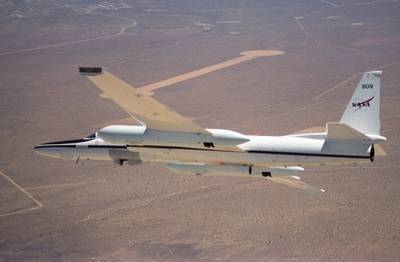
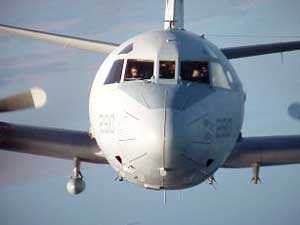
NASA's ER-2 high-altitude weather research plane and the National Oceanic and Atmospheric Administration's (NOAA) P3-Orion research aircraft flew several missions July 14, 15 and 16 into the turbulent tropical atmosphere over the eastern Pacific.

The flights were intended to investigate a breeding ground of tropical cyclones -- one of the core goals of NASA's Tropical Cloud Systems and Processes (TCSP) mission, which is being conducted throughout July from San Jose, Costa Rica.

The eastern Pacific is the most concentrated spawning ground of tropical cyclones, otherwise known as hurricanes, on the planet, averaging 10-12 a year. The NOAA's P3 aircraft flew five successive missions, each about eight hours in duration. Two were flown in coordination with the ER-2. The missions commenced July 14 because large-scale conditions in the region suggested birth of a hurricane was imminent.

Just days later, on July 18, Tropical Storm Eugene developed on the far western edge of the TCSP flight zone.

The NOAA's P3 provided data on winds in the lower and middle atmosphere, while the ER-2 supplied data on the entire vertical structure of cloud, precipitation and atmospheric temperature features. During several flights, numerous small-scale circulations were documented within the "Inter-Tropical Convergence Zone," a narrow region where northeasterly and southeasterly winds converge to form thunderstorms. When the vortices coincide with strong thunderstorms, and other large-scale oceanic and atmospheric conditions are favorable, a hurricane can be generated.

Much analysis will be needed to determine if the roots of Eugene's spin can be traced to one of the vortices measured during this intensive period. The ER-2 and NOAA's P3 will provide valuable data on precursor conditions within the broader region where Tropical Storm Eugene developed.

There are different theories on why hurricanes develop in the eastern Pacific. One theory suggests disturbances that perturb the flow in the eastern Pacific arrive in the form of tropical waves from Africa, while another theory suggests the initial source of spin is essentially "homegrown" -- rotation arising from local perturbations in the regional atmosphere.

By combining the rich datasets obtained from the ER-2 and P3 aircraft with data from the unpiloted Aerosonde aircraft -- which also has been flying surveillance missions over the eastern Pacific -- and with numerical prediction models, some answers to the crucial questions of hurricane genesis soon may be forthcoming.

FMI: www.nasa.gov/vision/earth/lookingatearth/hurricane_2005.html

Advertisement

More News

Four Companies Recognized With 2013 EBAA Safety Of Flight Awards

Cited For Focus On Maintaining And Improving Best Practices Four European companies have been recognized for their commitment to safe operations as recipients of the 2013 European >[...]

Classic Aero-TV: Viking Engines--Building A Rep For Alternative SportAv Engines

Rotax Is NOT The Only Player In Sport Aviation Propulsion Ya gotta hand to Viking... in an industry so VERY well dominated by Rotax, it takes some serious talent and extraordinary >[...]

ANN's Daily Aero-Linx (05.22.13)

The European Cockpit Association The European Cockpit Association (ECA) was created in 1991 and is the representative body of European pilots at European Union (EU) level. It repre>[...]

ANN's Daily Aero-Term (05.22.13): Known Traffic

With respect to ATC clearances, means aircraft whose altitude, position, and intentions are known to ATC.>[...]

Aero-News: Quote Of The Day (05.22.13)

"(T)he PC-24 is a completely new development – not a 'me too product'." Source: Oscar J. Schwenk, Chairman of the Board of Directors of Pilatus, introducing the company's new>[...]

blog comments powered by Disqus


Advertisement

Advertisement

Podcasts

Advertisement

© 2007 - 2013 Web Development & Design by Pauli Systems, LC