
Production of the New F-35 Engine Falls Another Six Months Behind | Aero-News Network
Aero-News Network
RSS icon RSS feed
podcast icon MP3 podcast
Subscribe Aero-News e-mail Newsletter Subscribe

Airborne Unlimited -- Most Recent Daily Episodes

Episode Date

Airborne-Monday

Airborne-Tuesday

Airborne-Wednesday Airborne-Thursday

Airborne-Friday

Airborne On YouTube

Airborne-Unlimited-12.01.25

AirborneNextGen-
12.02.25

Airborne-Unlimited-12.03.25

Airborne-FltTraining-12.04.25

AirborneUnlimited-12.05.25

AFE 2025 LIVE MOSAIC Town Hall (Archived): www.airborne-live.net

Wed, Oct 08, 2025

Production of the New F-35 Engine Falls Another Six Months Behind

F135 Lot 18 and 19 Contracts Pushed to Early 2026

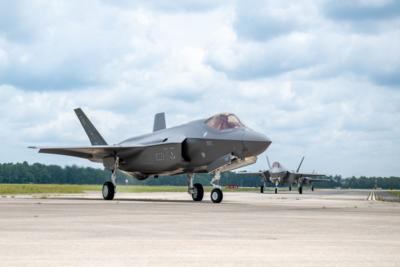
The expensive Lockheed Martin F-35 Lightning II program has now hit another snag, with deliveries of its new F135 engine now expected to fall another six months behind schedule. Pratt & Whitney, the Raytheon-owned company that builds the afterburning turbofan, has not disclosed a reason for the latest slip.

The setback adds to a long list of complications that have weighed down the F-35 program since its inception. The jet, produced in three variants for the U.S. Air Force, Navy, Marine Corps, and 19 allied nations, was designed to be a next-generation platform that would simplify logistics and save money. Instead, ballooning costs and recurring delays have made it the most expensive military procurement in history, surpassing even the B-29 and Manhattan Project.

Delays aside, the F-35’s strategic value has taken shape across the more than 1,300 aircraft delivered worldwide. A single airframe type across multiple services and nations gives Western air forces a significant logistical and tactical edge, allowing for shared parts, training, and battlefield data that ties allied fleets into a coordinated defensive network. While Russia’s Su-57 and China’s J-20 compete on paper, neither comes close to the global scale or integration of the F-35 fleet.

Pratt & Whitney’s F135 engine remains a key element of that set-up. Its roughly 43,000 pounds of thrust enables the F-35’s supersonic speed and vertical takeoff capabilities in the B variant. Even so, the engine has drawn scrutiny on much of the same fronts as the jet itself: maintenance costs, sustainment issues, and now, repeated production setbacks. The Joint Program Office confirmed plans to finalize Lot 18 and award Lot 19 contracts in spring 2026.

The government is not giving up just yet, however, with the Pentagon recently approving contracts for 300 new F-35 airframes worth $24 billion… even as the engines that power them remain in limbo.

FMI: www.lockheedmartin.com

Advertisement

More News

Aero-FAQ: Dave Juwel's Aviation Marketing Stories -- ITBOA BNITBOB

Dave Juwel's Aviation Marketing Stories ITBOA BNITBOB ... what does that mean? It's not gibberish, it's a lengthy acronym for "In The Business Of Aviation ... But Not In The Busine>[...]

NTSB Prelim: Rutan Long-EZ

The Pilot Attempted Several Times To Restart The Engine And Diverted To Long Beach Airport/Daughtery Field On October 20, 2025, about 1603 Pacific daylight time, an experimental am>[...]

ANN's Daily Aero-Term (12.05.25): Hazardous Weather Information

Hazardous Weather Information Summary of significant meteorological information (SIGMET/WS), convective significant meteorological information (convective SIGMET/WST), urgent pilot>[...]

Aero-News: Quote of the Day (12.05.25)

"The latest development underscores the government of Malaysia’s commitment in providing closure to the families affected by this tragedy..." Source: From statements made by >[...]

Airborne-Flight Training 12.04.25: Ldg Fee Danger, Av Mental Health, PC-7 MKX

Also: IAE Acquires Diamond Trainers, Army Drones, FedEx Pilots Warning, DA62 MPP To Dresden Tech Uni The danger to the flight training industry and our future pilots is clear. Dona>[...]

blog comments powered by Disqus



Advertisement

Advertisement

Podcasts

Advertisement

© 2007 - 2025 Web Development & Design by Pauli Systems, LC

