NASA Recycling Old Spacecraft For New Missions | Aero-News Network
Aero-News Network
RSS icon RSS feed
podcast icon MP3 podcast
Subscribe Aero-News e-mail Newsletter Subscribe

** AIRBORNE 06.18.13 Aero-TV-- CLICK HERE! ** HD iPad-Friendly Version -- AIRBORNE 06.18.13 **

** AIRBORNE 06.14.13 Aero-TV-- CLICK HERE! ** HD iPad-Friendly Version -- AIRBORNE 06.14.13**

** AIRBORNE 04.01.13 SPECIAL EDITION of Aero-TV-- CLICK HERE! ** HD iPad-Friendly Version -- AIRBORNE 04.01.13 SPECIAL EDITION **

Thu, Jul 05, 2007

NASA Recycling Old Spacecraft For New Missions

Deep Impact, Stardust To Be Re-Enlisted For Duty

When it comes to recycling, NASA engineers are quickly becoming experts on the matter. The space agency said Tuesday it plans to reuse two older spacecraft on new missions to study comets and planets around other stars.

The Los Angeles Times reports NASA's Stardust and Deep Impact probes will soon be re-enlisted to study other planetary bodies. Both spacecraft completed their primary missions within the past three years.

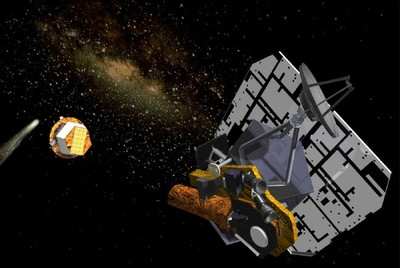
As ANN reported, Deep Impact sent a impactor probe into comet Tempel 1 in 2005, carving a crater and sending a debris cloud from the comet's core into space. The main spacecraft was put into safe mode shortly after, to conserve energy.

Stardust flew by comet Wild 2 in 2004, collecting interstellar matter with a specialized mitt before launching a recovery capsule back to Earth. Scientists have been giddily studying that matter ever since the capsule successfully touched down in the Utah desert in January 2006.

For its new mission, Stardust will be sent toward a 2011 rendezvous with Tempel 1, the first time a comet will be revisited. NASA hopes the probe will be able to capture images of the heavenly body, something Deep Impact failed to do (the debris cloud obstructed its view.)

As for Deep Impact, the space agency will reactivate the probe later this year for a planned two-part mission. NASA plans to use the probe as an observatory, collecting information on extrasolar planets and distant stars. In December 2008, the probe will also pass comet 85P/Boethin, becoming the first spacecraft to explore the small comet that was discovered in 1975.

Scientists hope Deep Impact will be able to collect information to determine if comets played a role in the emergence of life on Earth.

While NASA isn't saying how much the new missions will cost, the fact reusing the older spacecraft will be far cheaper than planning two new missions is obvious.

Michael A'Hearn, principal investigator for the Deep Impact team at the University of Maryland, says NASA allotted $30 million for the mission -- about $10 million less than researchers wanted. While disappointed, he told the Times the team will make it work.

FMI: www.nasa.gov

Advertisement

More News

Classic Aero-TV: Bob 'Mister FBO' Showalter -- Examining The Future Of Aviation

A True Aviation Pioneer Talks About The Future of GA Originally Webcast, 05.30.12: Even to many who have to compete with him, Bob Showalter is "Mr. FBO." A veteran of decades of se>[...]

AgustaWestland Displays Project Zero Tilt Rotor At Le Bourget

Electric VTOL Aircraft Is Turning Heads In France Among the thousands of aircraft and products on display at the Paris Air Show getting a lot of attention this week is one that may>[...]

ANN's Daily Aero-Linx (06.20.13)

Professional Helicopter Pilots Association This website provides valuable information to helicopter operators, including quick access to TFR maps, Homeland Security bulletins, form>[...]

ANN's Daily Aero-Term (06.20.13): Warm Advection

Transport of warm air into an area by horizontal winds. Low-level warm advection sometimes is referred to (erroneously) as overrunning. Although the two terms are not properly inte>[...]

Aero-News: Quote Of The Day (06.20.13)

“We have clearly heard the voice of scientists and their unanimous recommendations to change the proposal. From now on, nobody can claim ‘We did not know’." Sourc>[...]

blog comments powered by Disqus



Advertisement

Advertisement

Podcasts

Advertisement

© 2007 - 2013 Web Development & Design by Pauli Systems, LC