Trio From International Space Station Lands Safely In Kazakhstan | Aero-News Network
Aero-News Network
RSS icon RSS feed
podcast icon MP3 podcast
Subscribe Aero-News e-mail Newsletter Subscribe

** AIRBORNE 06.18.13 Aero-TV-- CLICK HERE! ** HD iPad-Friendly Version -- AIRBORNE 06.18.13 **

** AIRBORNE 06.14.13 Aero-TV-- CLICK HERE! ** HD iPad-Friendly Version -- AIRBORNE 06.14.13**

** AIRBORNE 04.01.13 SPECIAL EDITION of Aero-TV-- CLICK HERE! ** HD iPad-Friendly Version -- AIRBORNE 04.01.13 SPECIAL EDITION **

Tue, Jul 03, 2012

Trio From International Space Station Lands Safely In Kazakhstan

Sunday Landing Marks The End Of A Half-Year-Long Stay At The Station

Three members of the Expedition 31 crew undocked from the International Space Station and returned safely to Earth Sunday, July 1, wrapping up a mission that lasted six-and-a-half months.

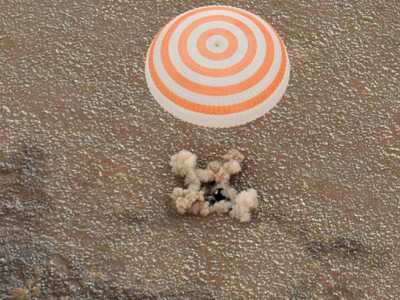
Russian Commander Oleg Kononenko, NASA Flight Engineer Don Pettit and European Space Agency Flight Engineer Andre Kuipers landed their Soyuz TMA-03M spacecraft in Kazakhstan at 3:14 a.m. CDT (2:14 p.m. local time) after undocking from the space station's Rassvet module at 11:47 p.m. June 30. The trio, which arrived at the station Dec. 23, 2011, spent a total of 193 days in space, 191 of which were aboard the station.

During their expedition, the crew supported more than 200 scientific investigations involving more than 400 researchers around the world. The studies ranged from integrated investigations of the human cardiovascular and immune systems to fluid, flame and robotic research.

Before leaving the station, Kononenko handed over command of Expedition 32 to the Russian Federal Space Agency's Gennady Padalka, who remains aboard the station with NASA astronaut Joe Acaba and Russian cosmonaut Sergei Revin. NASA astronaut Sunita Williams, Russian cosmonaut Yuri Malenchenko and Japan Aerospace Exploration Agency astronaut Akihiko Hoshide will join them July 17. Williams, Malenchenko and Hoshide are scheduled to launch July 14 from the Baikonur Cosmodrome in Kazakhstan.

On June 25, Pettit celebrated achieving one cumulative year in space, combining his time in orbit on Expedition 6, Expedition 30/31 and the STS-126 space shuttle Endeavour flight to the station in November 2008. Pettit now has 370 days in space, placing him fourth among U.S. space fliers for the longest time in space.

During Expedition 31, Pettit also used household objects aboard the station to perform a variety of unusual physics experiments for the video series "Science Off the Sphere." Through these demonstrations, Pettit showed more than a million Internet viewers how space affects scientific principles.

(NASA file image Soyuz landing in Kazakhstan)

FMI: www.nasa.gov

Advertisement

More News

Aero-TV: Garmin’s GNC-255 –- Back To Basics

Garmin's New Aviation VHF Radios Early this year, a new series of aviation VHF COM and NAV/COM radios, the GTR and GNC series, was announced by Garmin. As the replacement products >[...]

EADS And Siemens Enter Long-Term Research Partnership

Sign MoU With Diamond Aircraft On Electric Propulsion System EADS and Siemens are entering into a long-term research partnership to introduce new electric propulsion systems that c>[...]

ANN's Daily Aero-Term (06.19.13): Ceiling

The heights above the earth's surface of the lowest layer of clouds or obscuring phenomena that is reported as broken, overcast, or obscuration, and not classified as thin or parti>[...]

ANN's Daily Aero-Linx (06.19.13)

The Army Aviation Heritage Foundation The Army Aviation Heritage Foundation (AAHF) is a non-profit public educational foundation dedicated to presenting the Army Aviation story to >[...]

Aero-News: Quote Of The Day (06.19.13)

“The serial electric propulsion allows us to design airplanes with totally different characteristics than today. Vertical take-off and high-speed cruise can be realized in a >[...]

blog comments powered by Disqus



Advertisement

Advertisement

Podcasts

Advertisement

© 2007 - 2013 Web Development & Design by Pauli Systems, LC