WASPs Paved The Way For Future Generations Of Military Women To
Serve
On November 14, the same day the first woman was promoted to the
rank of four-star general, the "Fly Girls of World War II" exhibit
opened in honor of the first US military-trained women
aviators.
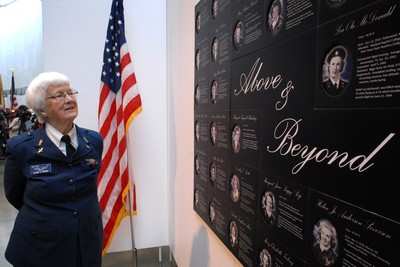
Like Army Gen. Ann E. Dunwoody, the Women Airforce Service
Pilots, better known as WASP, understood they were the first of
their kind, but knew others would follow, said National Public
Radio news analyst Cokie Roberts, who spoke at the exhibit's grand
opening here today at the Women In Military Service for America
Memorial.
"Women have contributed to all of America's Wars since the
Revolutionary War," Roberts said. "And it's so beautiful to have
these WASP here with us today."
The WASP flew everything from bomber jets to ferry planes but
most importantly, they paved the way for future generations of
military women to serve, she said.
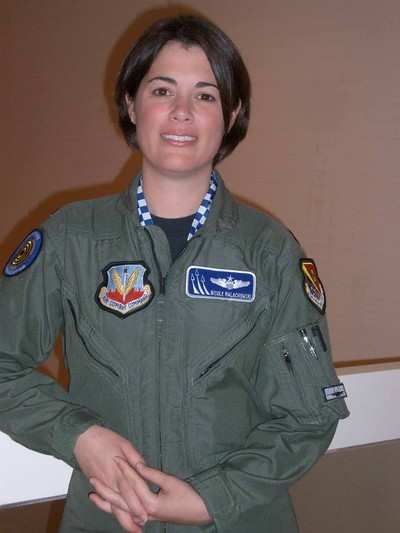
One such woman to follow in the WASP footsteps is Air Force Maj.
Nicole Malachowski, who also spoke at the ceremony. She's currently
a White House Fellow but is an experienced fighter pilot with more
than 180 hours of combat flight time. She was also the first woman
to fly with the Air Force's Thunderbird demonstration squadron.
"You didn't fly and serve your country because your were women
but, because you had to overcome some attitudes and restrictions at
the time, you managed to served your country in spite of being
women," Malachowski (shown below) said. "You had a dream; you
followed that dream, and your legacy inspired my dream."
Public attention and praise didn't always come easily for the
original fly girls. The WASP program only lasted for two years and
was disbanded in December 1944 because Congress wouldn't grant the
women military status. They were considered civil service employees
until the issue was brought up again in 1977 when they were finally
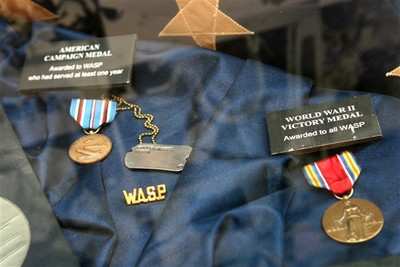
recognized as military veterans. A few years later, the women were
authorized to wear the World War II service and American Military
campaign medals, said Mary Cox, who served as a WASP through the
program's duration.
Though the program was short-lived and the battle for
recognition was long a one, the women still wear their wings with
pride. Many of them look back on their days test-flying bomber jets
and piloting transport planes as the best experience of their
lives, Cox said.
"It was only a two-year program," Cox said. "That's all it
lasted, but it was still quite an experience. For most of us girls
who survived this long, it's the main things in our life. No other
experience compares except for having and raising children."
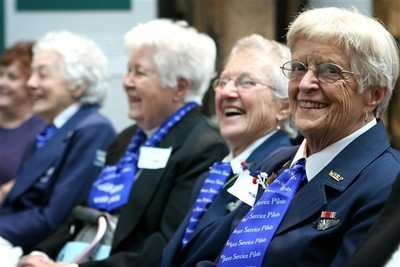
Many of those children and their families were here for the
exhibit's opening, along with 27 WASPs. Initially, more than 25,000
women pilots applied for the program, while less than 1,900 were
accepted. After training, 1,074 won their wings and were
transferred to military posts across the U.S. Today, fewer than 300
are living.
About 150 guests and supporters were among the first to view the
exhibit. Uniforms, pictures, training manuals, patches, pin-on
wings and other artifacts line the entire left side of the 200-foot
wall inside the Women In Military Service for America Memorial's
main corridor.
"We think it's marvelous that people remember what we did," said
Scotty Gough, 86, who served with the WASP for only one year
because she was one year too young when the program started. "I
loved flying so much that if I had had the money, I would've paid
the Air Force to let me fly."
"For many, many years people knew nothing about us, and it's
important for generations to know what we did and what we were. We
were the first ones to fly for the Army, and that's why today's
women are flying jets and in the Air Force."
(ANN salutes Army Staff Sgt. Michael J. Carden, American
Forces Press Service.)



 ANN's Daily Aero-Term (04.20.24): Light Gun
 See All