NASA Morpheus Lander Flight Test Fails | Aero-News Network
Aero-News Network
RSS icon RSS feed
podcast icon MP3 podcast
Subscribe Aero-News e-mail Newsletter Subscribe

** AIRBORNE 05.21.13 Aero-TV-- CLICK HERE! ** HD iPad-Friendly Version -- AIRBORNE 05.21.13 **

** AIRBORNE 05.17.13 Aero-TV-- CLICK HERE! ** HD iPad-Friendly Version -- AIRBORNE 05.17.13 **

** AIRBORNE 04.01.13 SPECIAL EDITION of Aero-TV-- CLICK HERE! ** HD iPad-Friendly Version -- AIRBORNE 04.01.13 SPECIAL EDITION **

Sat, Aug 11, 2012

NASA Morpheus Lander Flight Test Fails

Prototype Low-Cost Lander Crashed And Burned In First Autonomous Flight Test

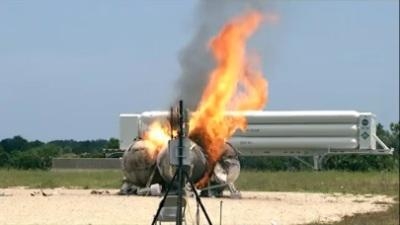
While NASA celebrates the success of the Curiosity Rover landing on Mars, another program suffered a setback Thursday when the Morpheus Lander prototype crashed and burned only a few seconds after lifting off on its first autonomous test flight.

In a video release, NASA said that "during the free flight test of the Project Morpheus vehicle at the Shuttle Landing Facility, the vehicle lifted off the ground and then experienced a hardware component failure. This failure prevented the vehicle from maintaining stable flight.

"No one was injured and the resulting fire was extinguished by Kennedy Space Center fire personnel.

"Failures such as these were anticipated prior to the test, and are part of the development process for any complex spaceflight hardware."

The Associated Press reports that NASA said the likely cause of the crash was component in the GPS navigation system.

Morpheus had successfully completed 19 tethered test flights before Thursday's first untethered attempt, including one last Friday.

According to the program's blog, Morpheus is a vertical test bed vehicle demonstrating new green propellant propulsion systems and autonomous landing and hazard detection technology.

Designed, developed, manufactured and operated in-house by engineers at NASA’s Johnson Space Center, the Morpheus Project represents not only a vehicle to advance technologies, but also an opportunity to try out “lean development” engineering practices.
 
Morpheus is a NASA-designed vehicle. It was manufactured and assembled at JSC and Armadillo Aerospace. Morpheus is large enough to carry 1,100 pounds of cargo to the moon – for example, a humanoid robot, a small rover, or a small laboratory to convert moon dust into oxygen – performing all propellant burns after the trans lunar injection. The primary focus of the test bed is to demonstrate an integrated propulsion and guidance, navigation and control system that can fly a lunar descent profile to exercise the Autonomous Landing and Hazard Avoidance Technology (ALHAT) safe landing sensors and closed-loop flight control.

The AP reports that NASA has spent some $7 million on the program, which includes parts for an as-yet-unbuilt second lander prototype.

(Image from NASA video)

FMI: www.nasa.gov

Advertisement

More News

Update: Startling... FAA Wants EAA To Pay Them To Staff Oshkosh

Could The FAA Get ANY Stranger? Worse Yet... Will They? ANN RealTime News Update, 0001ET, 05.23.13: The FAA has twice promised ANN a statement this day in order to understand some >[...]

Classic Aero-TV: EAA’s Jack Pelton – ‘Everything’s Going to Be OK’

Building A New Future For The EAA... One Issue At A Time Originally WebCast 11.14.12: With only a couple of weeks in pocket, directing the reorganization of the EAA in the wake of >[...]

House Committee Hearing Focuses On Strategic Stepping Stones To Mars

Subcommittee Chair Call Mars Mission A Congressional Priority The House Science Committee Subcommittee on Space held a hearing Tuesday to examine possible options for the next step>[...]

Dassault Falcon Embarks On Spares Pricing Overhaul

Third Such Restructuring In 10 Years Dassault Falcon has embarked on its third parts pricing overhaul in the past 10 years, assessing the cost of over 18,500 individual items. The >[...]

ANN's Daily Aero-Linx (05.23.13)

Chandelle Chandelle is meant to be a forum for original essays, reviews, photographs, and artwork related, however loosely, to the less familiar aspects of the history of aviation.>[...]

blog comments powered by Disqus



Advertisement

Advertisement

Podcasts

Advertisement

© 2007 - 2013 Web Development & Design by Pauli Systems, LC