Covering An Airplane With Fabric Is A Skill You Can Learn At Oshkosh | Aero-News Network
Aero-News Network
RSS icon RSS feed
podcast icon MP3 podcast
Subscribe Aero-News e-mail Newsletter Subscribe

** AIRBORNE 05.21.13 Aero-TV-- CLICK HERE! ** HD iPad-Friendly Version -- AIRBORNE 05.21.13 **

** AIRBORNE 05.17.13 Aero-TV-- CLICK HERE! ** HD iPad-Friendly Version -- AIRBORNE 05.17.13 **

** AIRBORNE 04.01.13 SPECIAL EDITION of Aero-TV-- CLICK HERE! ** HD iPad-Friendly Version -- AIRBORNE 04.01.13 SPECIAL EDITION **

Fri, Jul 27, 2012

Covering An Airplane With Fabric Is A Skill You Can Learn At Oshkosh

It's One Of The Early Steps Of Building An Airplane

By Maria Morrison

Now, anyone can learn how to ribstitch, cover, or poly-brush an airplane with the help of a group of people in a tent by the hangars. Here about 10 people teach about the various stages of building and aircraft when it is just a couple pieces of wood.

First, you have to do covering. This is where the wooden frame gets covered with fabric. Fabric is glued down and then smothered with acetone. this helps it stay forever. Once the fabric is all glued down, the people use a common household iron to shrink down the fabric and take out wrinkles. When the fabric is done, it can be shrunk by 12 percent.

The next step is the poly-brushing. Poly-brush is a pink liquid that fills the weave in the fabric. While the poly-brush is still wet, they put on the finishing tapes, which are long strips of fabric over the ribs.

After the poly-brushing is dry, people put chalk lines on the piece for ribstitches. The space between the lines depends on the type of aircraft, but they are normally 1-2 inches away from each other. Then, thin tapes are laid down in the middle of the finishing tapes, directly over the ribs. Holes for the stitches are pokes next to the tapes on the chalk lines.

Last is ribstitching. This is where the stitcher takes a long needle and a waxy string and threads it through the holes, tying special knots along the way. Stitching is required over the ribs to stop the fabric from bubbling up during flight, but it is also good to have anywhere that is out in the wind.

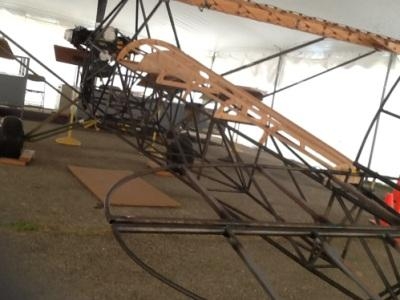
The booth had a Corben Baby Ace structure on display, along with many covered pieces of a J-1 and a Tripacer.

FMI: www.polyfiber.com

Advertisement

More News

Update: Startling... FAA Wants EAA To Pay Them To Staff Oshkosh

Could The FAA Get ANY Stranger? Worse Yet... Will They? ANN RealTime News Update, 1324ET, 05.23.13: Well... the statement we were promised YESTERDAY showed up today... and it doesn>[...]

Aspen Avionics Evolution Backup Display Expands To Piper Archer, Seminole

Aspen’s All Digital Backup Display Will Give Flight-Training Students The Total Glass Panel Experience Aspen Avionics announced Tuesday that Piper Aircraft has selected the E>[...]

Classic Aero-TV: EAA’s Jack Pelton – ‘Everything’s Going to Be OK’

Building A New Future For The EAA... One Issue At A Time Originally WebCast 11.14.12: With only a couple of weeks in pocket, directing the reorganization of the EAA in the wake of >[...]

House Committee Hearing Focuses On Strategic Stepping Stones To Mars

Subcommittee Chair Call Mars Mission A Congressional Priority The House Science Committee Subcommittee on Space held a hearing Tuesday to examine possible options for the next step>[...]

Dassault Falcon Embarks On Spares Pricing Overhaul

Third Such Restructuring In 10 Years Dassault Falcon has embarked on its third parts pricing overhaul in the past 10 years, assessing the cost of over 18,500 individual items. The >[...]

blog comments powered by Disqus


Advertisement

Advertisement

Podcasts

Advertisement

© 2007 - 2013 Web Development & Design by Pauli Systems, LC