Chemical Leak Causes Tense Moments On ISS | Aero-News Network
Aero-News Network
RSS icon RSS feed
podcast icon MP3 podcast
Subscribe Aero-News e-mail Newsletter Subscribe

** AIRBORNE 06.18.13 Aero-TV-- CLICK HERE! ** HD iPad-Friendly Version -- AIRBORNE 06.18.13 **

** AIRBORNE 06.14.13 Aero-TV-- CLICK HERE! ** HD iPad-Friendly Version -- AIRBORNE 06.14.13**

** AIRBORNE 04.01.13 SPECIAL EDITION of Aero-TV-- CLICK HERE! ** HD iPad-Friendly Version -- AIRBORNE 04.01.13 SPECIAL EDITION **

Mon, Sep 18, 2006

Chemical Leak Causes Tense Moments On ISS

Problem Generator Powered Down; Should Not Affect Expedition 14 Docking

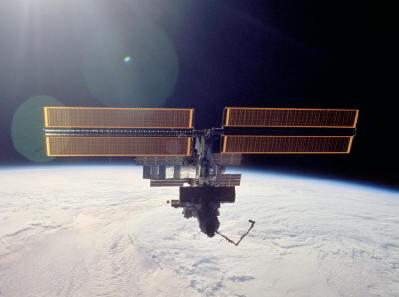
A big scare in space Monday... as NASA flight controllers declared an emergency aboard the International Space Station, when the three-member crew noticed what they first described as smoke, and smelled a foul odor.

Shortly before 7:30 am EDT, the Expedition 13 crew reported the odor in the Russian Zvezda Service Module, and manually activated an alarm to begin emergency procedures. The source of the odor was quickly determined to be an apparent leak of potassium hydroxide in the station's Elektron oxygen generation system.

Potassium hydroxide, or caustic potash, can be an irritant to crew members, but is not classified as a life-threatening toxin.

The crew donned surgical masks, goggles and gloves for protection from the apparently small leak. Continual measurements of the station atmosphere have indicated levels of any contaminants are very low. The crew also has begun a standard procedure to scrub the air onboard to ensure no potassium hydroxide vapors remain.

Expedition 13 Commander Pavel Vinogradov reported to Russian flight controllers at about 7:45 am that the situation had stabilized, and that he cleaned up a chemical near the Elektron oxygen generation system.

International Space Station Program Manager Mike Suffredini said the incident will have no impact on the upcoming arrival of the Expedition 14 crew on Wednesday. For the moment, however, Elektra remains cold, and there is some question whether the module can -- or should be -- powered back up.

Fortunately, there are plenty of spare parts for the Elektron, and NASA officials say they have plenty of oxygen candles and bottled O-2 on board. But if the Elektron can't be fixed... that could cause even bigger problems down the road.

FMI: www.nasa.gov

Advertisement

More News

Aero-TV: Garmin’s GNC-255 –- Back To Basics

Garmin's New Aviation VHF Radios Early this year, a new series of aviation VHF COM and NAV/COM radios, the GTR and GNC series, was announced by Garmin. As the replacement products >[...]

EADS And Siemens Enter Long-Term Research Partnership

Sign MoU With Diamond Aircraft On Electric Propulsion System EADS and Siemens are entering into a long-term research partnership to introduce new electric propulsion systems that c>[...]

ANN's Daily Aero-Term (06.19.13): Ceiling

The heights above the earth's surface of the lowest layer of clouds or obscuring phenomena that is reported as broken, overcast, or obscuration, and not classified as thin or parti>[...]

ANN's Daily Aero-Linx (06.19.13)

The Army Aviation Heritage Foundation The Army Aviation Heritage Foundation (AAHF) is a non-profit public educational foundation dedicated to presenting the Army Aviation story to >[...]

Aero-News: Quote Of The Day (06.19.13)

“The serial electric propulsion allows us to design airplanes with totally different characteristics than today. Vertical take-off and high-speed cruise can be realized in a >[...]

blog comments powered by Disqus


Advertisement

Advertisement

Podcasts

Advertisement

© 2007 - 2013 Web Development & Design by Pauli Systems, LC