

NuSTAR Launched From Pacific Atoll | Aero-News Network
Aero-News Network
RSS icon RSS feed
podcast icon MP3 podcast
Subscribe Aero-News e-mail Newsletter Subscribe

** AIRBORNE 05.21.13 Aero-TV-- CLICK HERE! ** HD iPad-Friendly Version -- AIRBORNE 05.21.13 **

** AIRBORNE 05.17.13 Aero-TV-- CLICK HERE! ** HD iPad-Friendly Version -- AIRBORNE 05.17.13 **

** AIRBORNE 04.01.13 SPECIAL EDITION of Aero-TV-- CLICK HERE! ** HD iPad-Friendly Version -- AIRBORNE 04.01.13 SPECIAL EDITION **

Thu, Jun 14, 2012

NuSTAR Launched From Pacific Atoll

NASA Confirms Successful Deployment Of Solar Arrays

NASA's Nuclear Spectroscopic Telescope Array (NuSTAR) launched into the morning skies over the central Pacific Ocean at noon EDT (0900 PDT) Wednesday, beginning its mission to unveil secrets of buried black holes and other exotic objects.

"We all eagerly await the launch of this novel X-ray observatory," said Paul Hertz, NASA's Astrophysics Division Director. "With its unprecedented spatial and spectral resolution to the previously poorly explored hard X-ray region of the electromagnetic spectrum, NuSTAR will open a new window on the universe and will provide complementary data to NASA's larger missions including Fermi, Chandra, Hubble and Spitzer."

NuSTAR will use a unique set of eyes to see the highest energy X-ray light from the cosmos. The observatory can see through gas and dust to reveal black holes lurking in our Milky Way galaxy, as well as those hidden in the hearts of faraway galaxies. "NuSTAR will help us find the most elusive and most energetic black holes, to help us understand the structure of the universe," said Fiona Harrison, the mission's principal investigator at the California Institute of Technology in Pasadena.

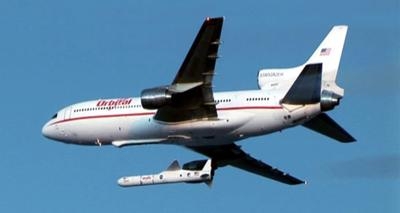
The observatory began its journey aboard the L-1011 "Stargazer" aircraft, operated by Orbital Sciences Corporation, Dulles, VA. NuSTAR was perched atop Orbital's Pegasus XL rocket, both of which were strapped to the belly of the Stargazer plane. The plane left Kwajalein Atoll in the central Pacific Ocean one hour before launch. At 0900:35 PDT, the rocket dropped, free-falling for five seconds before firing its first-stage motor.

About 13 minutes after the rocket dropped, NuSTAR separated from the rocket, reaching its final low Earth orbit. The first signal from the spacecraft was received at  0914 PDT) through NASA's Tracking and Data Relay Satellite System. "NuSTAR spread its solar panels to charge the spacecraft battery and then reported back to Earth of its good health," said Yunjin Kim, the mission's project manager at NASA's Jet Propulsion Laboratory in Pasadena, Calif. "We are checking out the spacecraft now and are excited to tune into the high-energy X-ray sky."

The mission's unique telescope design includes a 33-foot (10-meter) mast, which was folded up in a small canister during launch. In about seven days, engineers will command the mast to extend, enabling the telescope to focus properly. About 23 days later, science operations are scheduled to begin. In addition to black holes and their powerful jets, NuSTAR will study a host of high-energy objects in our universe, including the remains of exploded stars; compact, dead stars; and clusters of galaxies. The mission's observations, in coordination with other telescopes such as NASA's Chandra X-ray Observatory, which detects lower-energy X-rays, will help solve fundamental cosmic mysteries. NuSTAR also will study our sun's fiery atmosphere, looking for clues as to how it is heated. (Images provided by NASA)

FMI: www.nasa.gov/nustar

Advertisement

More News

X-47B Accomplishes Its First Ever Carrier Touch And Go

Maneuver Performed Aboard CVN 77 The Navy's X-47B Unmanned Combat Air System Demonstrator (UCAS-D) began touch and go landing operations aboard the aircraft carrier USS George H.W.>[...]

Honeywell's New HTF7350 Engine To Power Bombardier Challenger 350

HTF7000 Series Surpasses 1.5 Million Flight Hours With Better Than 99 Percent Dispatch Reliability Honeywell has announced that its HTF7350, the latest engine to join its successfu>[...]

Airborne 05.21.13: Cirrus Chute Fails, NASA Record, More NIMBY Nonsense

Also: PC-12 Record, Maule Nation, Cockpit Lockout, 34,000 Airliners Needed, Beechcraft Wins Big Contract You know you're having a bad day when a flight goes so bad that you feel yo>[...]

Helo Crew Missing From Vietnam War Accounted For, Interred At Arlington

Four Buried As A Group May 2 A Navy Pilot, missing from the Vietnam War, has been accounted-for and was buried with full military honors along with his crew. According to the Depar>[...]

ANN's Daily Aero-Linx (05.21.13)

Forest Service Smoke Jumpers Smokejumping was first proposed in 1934 by T.V. Pearson, the Forest Service Intermountain Regional Forester, as a means to quickly provide initial atta>[...]

blog comments powered by Disqus



Advertisement

Advertisement

Podcasts

Advertisement

© 2007 - 2013 Web Development & Design by Pauli Systems, LC