
NTSB's Final Report on Alaska Air 261 Published | Aero-News Network
Aero-News Network
RSS icon RSS feed
podcast icon MP3 podcast
Subscribe Aero-News e-mail Newsletter Subscribe

** AIRBORNE 05.21.13 Aero-TV-- CLICK HERE! ** HD iPad-Friendly Version -- AIRBORNE 05.21.13 **

** AIRBORNE 05.17.13 Aero-TV-- CLICK HERE! ** HD iPad-Friendly Version -- AIRBORNE 05.17.13 **

** AIRBORNE 04.01.13 SPECIAL EDITION of Aero-TV-- CLICK HERE! ** HD iPad-Friendly Version -- AIRBORNE 04.01.13 SPECIAL EDITION **

Fri, Jan 17, 2003

NTSB's Final Report on Alaska Air 261 Published

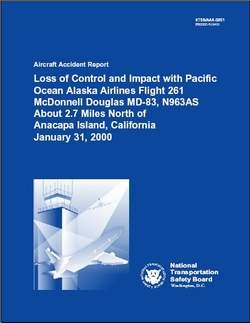
The NTSB has published an exhaustive final report on its investigation into the fatal crash of Alaska Air 261 on January 31, 2000. The accident occured about 2.7 Miles North of Anacapa Island, California and involved a McDonnell Douglas MD-83, N963AS. 

The NTSB's executive summary states that, "On January 31, 2000, about 1621 Pacific standard time, Alaska Airlines, Inc., flight 261, a McDonnell Douglas MD-83, N963AS, crashed into the Pacific Ocean about 2.7 miles north of Anacapa Island, California. The 2 pilots, 3 cabin crewmembers, and 83 passengers on board were killed, and the airplane was destroyed by impact forces. Flight 261 was operating as a scheduled international passenger flight under the provisions of 14 Code of Federal Regulations Part 121 from Lic Gustavo Diaz Ordaz International Airport, Puerto Vallarta, Mexico, to Seattle-Tacoma International Airport, Seattle, Washington, with an intermediate stop planned at San Francisco International Airport, San Francisco, California. Visual meteorological conditions prevailed for the flight, which operated on an instrument flight rules flight plan.

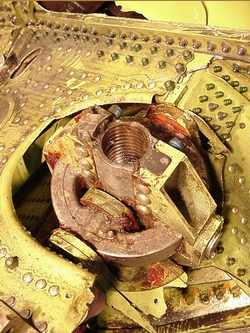
The National Transportation Safety Board determines that the probable cause of this accident was a loss of airplane pitch control resulting from the in-flight failure of the horizontal stabilizer trim system jackscrew assembly’s acme nut threads. The thread failure was caused by excessive wear resulting from Alaska Airlines’ insufficient lubrication of the jackscrew assembly.

Contributing to the accident were Alaska Airlines’ extended lubrication interval and the Federal Aviation Administration’s (FAA) approval of that extension, which increased the likelihood that a missed or inadequate lubrication would result in excessive wear of the acme nut threads, and Alaska Airlines’ extended end play check interval and the FAA’s approval of that extension, which allowed the excessive wear of the acme nut threads to progress to failure without the opportunity for detection. Also contributing to the accident was the absence on the McDonnell Douglas MD-80 of a fail-safe mechanism to prevent the catastrophic effects of total acme nut thread loss.

The safety issues discussed in this report include lubrication and inspection of the jackscrew assembly, extension of lubrication and end play check intervals, jackscrew assembly overhaul procedures, the design and certification of the MD-80 horizontal stabilizer trim control system, Alaska Airlines’ maintenance program, and FAA oversight of Alaska Airlines. Safety recommendations are addressed to the FAA."

FMI: http://www.ntsb.gov/publictn/2002/AAR0201.htm

Advertisement

More News

X-47B Accomplishes Its First Ever Carrier Touch And Go

Maneuver Performed Aboard CVN 77 The Navy's X-47B Unmanned Combat Air System Demonstrator (UCAS-D) began touch and go landing operations aboard the aircraft carrier USS George H.W.>[...]

Honeywell's New HTF7350 Engine To Power Bombardier Challenger 350

HTF7000 Series Surpasses 1.5 Million Flight Hours With Better Than 99 Percent Dispatch Reliability Honeywell has announced that its HTF7350, the latest engine to join its successfu>[...]

Airborne 05.21.13: Cirrus Chute Fails, NASA Record, More NIMBY Nonsense

Also: PC-12 Record, Maule Nation, Cockpit Lockout, 34,000 Airliners Needed, Beechcraft Wins Big Contract You know you're having a bad day when a flight goes so bad that you feel yo>[...]

Helo Crew Missing From Vietnam War Accounted For, Interred At Arlington

Four Buried As A Group May 2 A Navy Pilot, missing from the Vietnam War, has been accounted-for and was buried with full military honors along with his crew. According to the Depar>[...]

ANN's Daily Aero-Linx (05.21.13)

Forest Service Smoke Jumpers Smokejumping was first proposed in 1934 by T.V. Pearson, the Forest Service Intermountain Regional Forester, as a means to quickly provide initial atta>[...]

blog comments powered by Disqus



Advertisement

Advertisement

Podcasts

Advertisement

© 2007 - 2013 Web Development & Design by Pauli Systems, LC