"Tea Leaves" Portend Trouble On User Fee Issue
 It's a critical skill among
knowledgeable Washington players -- parsing politicians' public
statements to determine what really is happening. It's called
"reading the tea leaves"... and the Aircraft Owners and Pilots
Association is troubled by what it sees between the lines.
It's a critical skill among
knowledgeable Washington players -- parsing politicians' public
statements to determine what really is happening. It's called
"reading the tea leaves"... and the Aircraft Owners and Pilots
Association is troubled by what it sees between the lines.
"I've got to tell you, general aviation should be very
concerned, based on what I heard Tuesday," said Andy Cebula, AOPA
executive vice president of government affairs... and veteran
tealeaf reader.
What Cebula heard was the president's State of the Union
address, and Secretary of Transportation Mary Peters'
speech to the Washington Aero Club. Taken together,
the tea leaves say that the administration has plans for higher
taxes or user fees -- or both -- for aviation.
Start with President Bush's overarching goal with federal
spending: "We must balance the federal budget," he said in the
State of the Union speech. "We can do so without raising taxes."
And he promised to submit a budget that "eliminates the federal
deficit within the next five years."
That won't be easy to do.
The Office of Management and Budget, in its mid-session review,
predicts that the fiscal year 2007 deficit will be $339 billion
(not counting Social Security obligations). That means that by
September 30 (the end of fiscal year 2007), the federal government
will have spent $339 billion more than it received.
To make a dent in that deficit without raising taxes would mean
significant cuts in some federal programs -- or finding new revenue
sources that would not be classified as taxes. Like user fees.
Now, consider what Secretary Peters said at the Washington Aero
Club on January 23.
"We must retool and rethink our policies, and our financing, to
bring them in the twenty-first century," she said. "The importance
of getting a financing bill that ties revenues to costs and allows
us to manage the FAA more efficiently cannot be overstated."
How do you "tie revenues to costs?" User fees would do it in the
most direct fashion.
"The FAA needs a new funding mechanism, and...we must have
incentives in place that will make the system more efficient and as
well as more responsive to user needs," Peters said.
"That echoes an argument that user fee proponents have advanced
for years," said Cebula. "Charging by flight or ATC contact would
make the system 'responsive' because users would only pay for what
they need and make it 'efficient' because price would control
demand.
"But the FAA isn't selling widgets; it's ensuring safety," said
Cebula. "You don't buy safety by the piece."
And when Secretary Peters had the opportunity to exclude the
possibility of user fees, she did not.
"I know that user fees and who pays are big concerns for many of
you, but we must not lose sight of the broader issues at stake,"
Peters told the Aero Club. "I want to ask you to focus [your]
passion beyond your individual special interests to the broader
challenges facing aviation and the nation."
Noting that the current FAA funding legislation will terminate
this year, Peters said, "Expiration of the FAA authorization and
[aviation] trust fund financing provides a once-in-a-decade
opportunity to rewrite the book when it comes to America's aviation
policies."
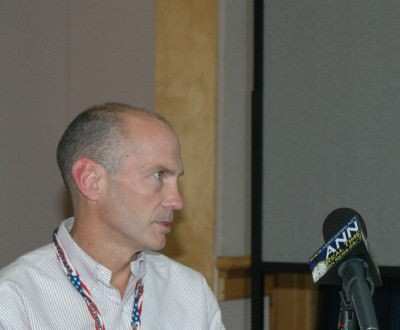
Said AOPA's Cebula (below), "This speech was undoubtedly cleared
by the White House, and it gives a pretty clear indication of the
administration's intent to change the current FAA funding
mechanism, a system that has worked reliably for nearly four
decades."
The next major indicator of intent will be the president's
fiscal year 2008 budget that he will send to Congress in early
February.
"We'll be able to tell precisely from those numbers if the
administration is going to try to push Congress to change the
source of money for the FAA," said AOPA President Phil Boyer. "With
the help of our more than 409,000 members, we're going to push back
-- very hard."



 Aero-News: Quote of the Day (04.17.24)


 See All