Tue, Aug 18, 2009
Amino Acid Glycine In Samples Returned From Wild 2
 NASA scientists have discovered glycine, a fundamental
building block of life, in samples of comet Wild 2 returned by
NASA's Stardust spacecraft.
NASA scientists have discovered glycine, a fundamental
building block of life, in samples of comet Wild 2 returned by
NASA's Stardust spacecraft.
"Glycine is an amino acid used by living organisms to make
proteins, and this is the first time an amino acid has been found
in a comet," said Jamie Elsila of NASA's Goddard Space Flight
Center in Greenbelt, MD. "Our discovery supports the theory that
some of life's ingredients formed in space and were delivered to
Earth long ago by meteorite and comet impacts."
Elsila is the lead author of a paper on this research accepted for
publication in the journal Meteoritics and Planetary Science. The
research was presented during the meeting of the American Chemical
Society at the Marriott Metro Center in Washington, D.C., August
16.
"The discovery of glycine in a comet supports the idea that the
fundamental building blocks of life are prevalent in space, and
strengthens the argument that life in the universe may be common
rather than rare," said Carl Pilcher, director of the NASA
Astrobiology Institute, which co-funded the research.
Stardust passed through dense gas and dust surrounding the icy
nucleus of Wild 2 (pronounced "Vilt-2") on Jan. 2, 2004. As the
spacecraft flew through this material, a special collection grid
filled with aerogel - a novel sponge-like material that's more than
99 percent empty space - gently captured samples of the comet's gas
and dust. The grid was stowed in a capsule that detached from the
spacecraft and parachuted to Earth on Jan. 15, 2006. Since then,
scientists around the world have been busy analyzing the samples to
learn the secrets of comet formation and our solar system's
history.
"We actually analyzed aluminum foil from the sides of tiny chambers
that hold the aerogel in the collection grid," said Elsila. "As gas
molecules passed through the aerogel, some stuck to the foil. We
spent two years testing and developing our equipment to make it
accurate and sensitive enough to analyze such incredibly tiny
samples."
Earlier, preliminary analysis in the Goddard labs detected glycine
in both the foil and a sample of the aerogel. However, since
glycine is used by terrestrial life, at first the team was unable
to rule out contamination from sources on Earth. "It was possible
that the glycine we found originated from handling or manufacture
of the Stardust spacecraft itself," said Elsila. The new research
used isotopic analysis of the foil to rule out that
possibility.
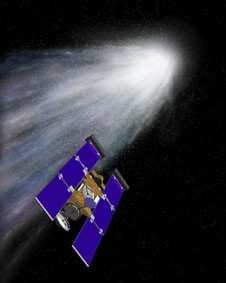
Wild 2 Artist's Concept
The team includes Daniel Glavin and Jason Dworkin of NASA
Goddard. "Based on the foil and aerogel results it is highly
probable that the entire comet-exposed side of the Stardust sample
collection grid is coated with glycine that formed in space,"
Glavin said.
"The discovery of amino acids in the returned comet sample is very
exciting and profound," said Stardust Principal Investigator Donald
E. Brownlee, a professor at the University of Washington, Seattle.
"It is also a remarkable triumph that highlights the advancing
capabilities of laboratory studies of primitive extraterrestrial
materials."
More News
Also: B-29 Superfortress Reunion, FAA Wants Controllers, Spirit Airlines Pulls Back, Gogo Galileo Van's Aircraft posted a short video recapping the goings-on around their reorganiz>[...]
Light Gun A handheld directional light signaling device which emits a brilliant narrow beam of white, green, or red light as selected by the tower controller. The color and type of>[...]
"The journey to this achievement started nearly a decade ago when a freshly commissioned Gentry, driven by a fascination with new technologies and a desire to contribute significan>[...]
"Our driven and innovative team of military and civilian Airmen delivers combat power daily, ensuring our nation is ready today and tomorrow." Source: General Duke Richardson, AFMC>[...]
Aircraft Conflict Predicted conflict, within EDST of two aircraft, or between aircraft and airspace. A Red alert is used for conflicts when the predicted minimum separation is 5 na>[...]



 Airborne 04.16.24: RV Update, Affordable Flying Expo, Diamond Lil
 See All