
Cassini Exposes Saturn's Two-Face Moon | Aero-News Network
Aero-News Network
RSS icon RSS feed
podcast icon MP3 podcast
Subscribe Aero-News e-mail Newsletter Subscribe

** AIRBORNE 05.21.13 Aero-TV-- CLICK HERE! ** HD iPad-Friendly Version -- AIRBORNE 05.21.13 **

** AIRBORNE 05.17.13 Aero-TV-- CLICK HERE! ** HD iPad-Friendly Version -- AIRBORNE 05.17.13 **

** AIRBORNE 04.01.13 SPECIAL EDITION of Aero-TV-- CLICK HERE! ** HD iPad-Friendly Version -- AIRBORNE 04.01.13 SPECIAL EDITION **

Fri, Jul 16, 2004

Cassini Exposes Saturn's Two-Face Moon

From JPL...

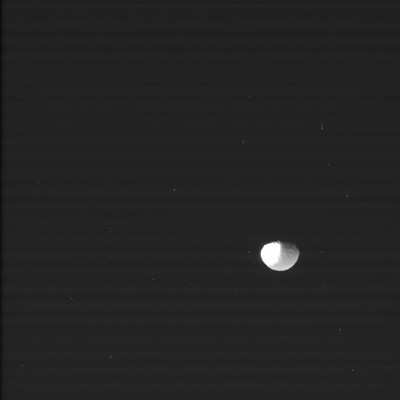
The moon with the split personality, Iapetus, presents a perplexing appearance in the latest images snapped by the Cassini spacecraft.

One hemisphere of the moon is very dark, while the other is very bright. Scientists do not yet know the origin of the dark material or whether or not it is representative of the interior of Iapetus.

Iapetus (pronounced eye-APP-eh-tuss) is one of Saturn's 31 known moons. Its diameter is about one third that of our own moon at 1,436 kilometers (892 miles). This image was taken in visible light with the Cassini spacecraft narrow angle camera on July 3, 2004, from a distance of 3 million kilometers (1.8 million miles) from Iapetus. The brightness variations in this image are not due to shadowing, they are real.

During Cassini's four-year tour, the spacecraft will continue to image Iapetus and conduct two close encounters. One of those encounters, several years from now, will be at a mere 1,000 kilometers (622 miles).

Iapetus was discovered by the Italian-French astronomer Jean Dominique Cassini in 1672. He correctly deduced that the trailing hemisphere is composed of highly reflective material, while the leading hemisphere is strikingly darker.

This sets Iapetus apart from Saturn's other moons and Jupiter's moons, which tend to be brighter on their leading hemispheres. Voyager images show that the bright side of Iapetus, which reflects nearly 50 percent of the light it receives, is fairly typical of a heavily cratered icy satellite. The leading side consists of much darker, redder material that has a reflectivity of only about 3 to 4 percent.

One scenario for the outside deposit of material has dark particles being ejected from Saturn's little moon Phoebe and drifting inward to coat Iapetus. One observation lending credence to an internal origin is the concentration of material on crater floors, which is suggestive of something filling in the craters. 

Iapetus is odd in other respects. It is in a moderately inclined orbit, one that takes it far above and below the plane in which the rings and most of the moons orbit. It is less dense than many of the other satellites, which suggests a higher fraction of ice or possibly methane or ammonia in its interior.

FMI: http://saturn.jpl.nasa.gov

Advertisement

More News

Four Companies Recognized With 2013 EBAA Safety Of Flight Awards

Cited For Focus On Maintaining And Improving Best Practices Four European companies have been recognized for their commitment to safe operations as recipients of the 2013 European >[...]

Classic Aero-TV: Viking Engines--Building A Rep For Alternative SportAv Engines

Rotax Is NOT The Only Player In Sport Aviation Propulsion Ya gotta hand to Viking... in an industry so VERY well dominated by Rotax, it takes some serious talent and extraordinary >[...]

ANN's Daily Aero-Linx (05.22.13)

The European Cockpit Association The European Cockpit Association (ECA) was created in 1991 and is the representative body of European pilots at European Union (EU) level. It repre>[...]

ANN's Daily Aero-Term (05.22.13): Known Traffic

With respect to ATC clearances, means aircraft whose altitude, position, and intentions are known to ATC.>[...]

Aero-News: Quote Of The Day (05.22.13)

"(T)he PC-24 is a completely new development – not a 'me too product'." Source: Oscar J. Schwenk, Chairman of the Board of Directors of Pilatus, introducing the company's new>[...]

blog comments powered by Disqus



Advertisement

Advertisement

Podcasts

Advertisement

© 2007 - 2013 Web Development & Design by Pauli Systems, LC