
King Schools Revises Online Icing Course To Cover 'Gotchas' | Aero-News Network
Aero-News Network
RSS icon RSS feed
podcast icon MP3 podcast
Subscribe Aero-News e-mail Newsletter Subscribe

** AIRBORNE 05.24.13 Aero-TV-- CLICK HERE! ** HD iPad-Friendly Version -- AIRBORNE 05.24.13 **

** AIRBORNE 05.21.13 Aero-TV-- CLICK HERE! ** HD iPad-Friendly Version -- AIRBORNE 05.21.13 **

** AIRBORNE 04.01.13 SPECIAL EDITION of Aero-TV-- CLICK HERE! ** HD iPad-Friendly Version -- AIRBORNE 04.01.13 SPECIAL EDITION **

Thu, Apr 16, 2009

King Schools Revises Online Icing Course To Cover 'Gotchas'

Notes Special Procedures To Recover From Tail-Plane Stalls

Usually, flying an airplane is a pretty straightforward operation... but King Schools notes flying in icing conditions seems to hold surprising pitfalls for pilots.

"First, there is the remarkable fact that the recovery from a tail-plane stall induced by icing requires a completely opposite technique from recovering from a wing stall," said John King, Co-Chairman of King Schools,

Added Martha King, the other Co-Chairman of King Schools, "Every pilot knows that recovering from a wing stall requires applying forward stick to lower the nose and reduce the angle of attack of the wing. On the other hand, recovering from an icing-induced tail-plane stall is completely counter-intuitive. It requires applying aft stick pressure."

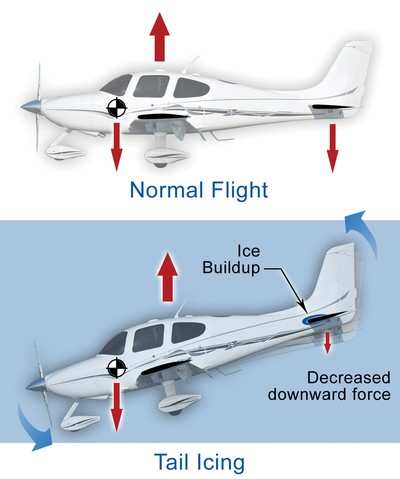
Why aft stick pressure? The Kings explain while the wing is providing upward force (lift), the tail is providing downward force. This helps to make the airplane stable. Anything that increases the angle of attack of one, decreases the angle of attack of the other.

So while a pitch-up increases the angle of attack of the wing, it decreases the angle of attack of the tail-plane. Plus, raising the elevator increases the camber of the tail-plane, reducing its stalling speed just the way increasing flaps increases the camber of the wing and decreases the stalling speed of the wing. The net result is that to recover from a tail-plane stall requires aft stick pressure.

"The problem is that it is extremely difficult to tell the difference between a tail-plane stall and a wing stall," said John.

"Adding to the difficulty," says Martha, "is the fact that the mere presence of icing conditions seems to distract pilots enough so that they forget the basics. Recently there have been several crashes as a result of pilots in icing conditions failing to add power when leveling off from a descent or putting down flaps and gear."

According to the Kings, it is clear pilots need help when dealing with icing conditions. "That's why King Schools recently revised our online Icing Operations course to beef up the section on tail-plane stall recognition and recovery," says John.

"If you fly on instruments long enough, you will eventually encounter icing conditions," Martha adds. "When you do, the information in this course will be vitally important. We want pilots to have the knowledge and confidence they need to do the right thing when it really counts."

FMI: www.kingschoolsonline.com

Advertisement

More News

ANN's Daily Aero-Linx (05.24.13)

Stormbirds A confederation of Luftwaffe-related web sites, providing reference-grade coverage of the Messerschmidt 262 and other advanced combat aircraft of the Third Reich.>[...]

ANN's Daily Aero-Term (05.24.13): Terrain/Obstruction Alert

A safety alert issued by ATC to aircraft under their control if ATC is aware the aircraft is at an altitude which, in the controller's judgment, places the aircraft in unsafe proxi>[...]

Aero-News: Quote Of The Day (05.24.13)

"You have a huge job ahead of you. The challenges are many and the solutions are hard." Source: Senate Commerce Committee Chair Jay Rockefeller (D-WV).>[...]

ANN FAQ: ANN's News Portal Syndication Program

Get A Customized ANN News Portal For YOUR Website! As we promised, the ever-so-busy software geeks at ANN have been working overtime on a number of cool new tools and toys... and t>[...]

AF Seven Summits Team Scales Everest

Effort To Raise Funds And Awareness For The Special Operations Warrior Foundation A group of Airmen with the Air Force Seven Summits team reached the highest point of the world, Mo>[...]

blog comments powered by Disqus


Advertisement

Advertisement

Podcasts

Advertisement

© 2007 - 2013 Web Development & Design by Pauli Systems, LC