
Boeing's A160 Hummingbird Unmanned Aircraft Resumes Testing | Aero-News Network
Aero-News Network
RSS icon RSS feed
podcast icon MP3 podcast
Subscribe Aero-News e-mail Newsletter Subscribe

** AIRBORNE 06.18.13 Aero-TV-- CLICK HERE! ** HD iPad-Friendly Version -- AIRBORNE 06.18.13 **

** AIRBORNE 06.14.13 Aero-TV-- CLICK HERE! ** HD iPad-Friendly Version -- AIRBORNE 06.14.13**

** AIRBORNE 04.01.13 SPECIAL EDITION of Aero-TV-- CLICK HERE! ** HD iPad-Friendly Version -- AIRBORNE 04.01.13 SPECIAL EDITION **

Fri, Nov 17, 2006

Boeing's A160 Hummingbird Unmanned Aircraft Resumes Testing

Powered By Subaru 6-Cylinder Engine

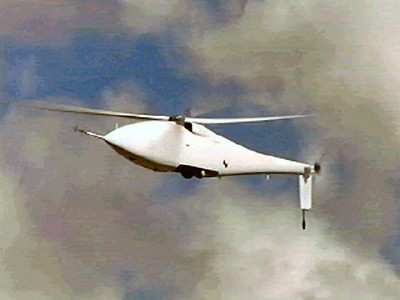
After nearly a year since its first flight with an uprated powerplant, Boeing's A160 Hummingbird unmanned aerial vehicle (UAV) returned to the skies over as Victorville, CA last week. Flight testing on the autonomous rotorcraft resumed November 8.

A team of test engineers from Boeing and the Defense Advanced Research Projects Agency (DARPA) put the A160 through its paces in a 45-minute test that included both hover and forward flight.

"The success of this latest flight is a tribute to the hard work of the Boeing and DARPA A160 team," said Jim Martin, Boeing A160 program manager. "This innovative unmanned aerial system continues to prove its versatility through a rigorous flight test program."

This current series of test flights is being conducted using the six-cylinder Subaru gasoline engine variant. Engineers will analyze the flight data and determine objectives for subsequent test flights at the same time that work continues in parallel toward the first flight of the turbine-powered A160T next spring.

The A160 Hummingbird has accumulated more than 1,000 ground test hours and 58.5 flight hours during 32 flights. The autonomous UAV is 35 feet long with a 36-foot rotor diameter and will fly up to 140 knots with a ceiling of 25-30,000 ft. (high hover capability up to 15,000 ft.) for up to 20 hours.

Boeing says operational A160Ts will be capable of performing persistent intelligence, surveillance and reconnaissance; target acquisition; communication relay and precision re-supply missions.

FMI: www.boeing.com

Advertisement

More News

Aero-TV: Garmin’s GNC-255 –- Back To Basics

Garmin's New Aviation VHF Radios Early this year, a new series of aviation VHF COM and NAV/COM radios, the GTR and GNC series, was announced by Garmin. As the replacement products >[...]

EADS And Siemens Enter Long-Term Research Partnership

Sign MoU With Diamond Aircraft On Electric Propulsion System EADS and Siemens are entering into a long-term research partnership to introduce new electric propulsion systems that c>[...]

ANN's Daily Aero-Term (06.19.13): Ceiling

The heights above the earth's surface of the lowest layer of clouds or obscuring phenomena that is reported as broken, overcast, or obscuration, and not classified as thin or parti>[...]

ANN's Daily Aero-Linx (06.19.13)

The Army Aviation Heritage Foundation The Army Aviation Heritage Foundation (AAHF) is a non-profit public educational foundation dedicated to presenting the Army Aviation story to >[...]

Aero-News: Quote Of The Day (06.19.13)

“The serial electric propulsion allows us to design airplanes with totally different characteristics than today. Vertical take-off and high-speed cruise can be realized in a >[...]

blog comments powered by Disqus


Advertisement

Advertisement

Podcasts

Advertisement

© 2007 - 2013 Web Development & Design by Pauli Systems, LC