Continues Tradition Started By Shepard's 1961 Flight
 Three service members with the US
Navy are part of the crew of NASA's space shuttle Discovery, which
is now on its way to a Monday rendezvous with the International
Space Station.
Three service members with the US
Navy are part of the crew of NASA's space shuttle Discovery, which
is now on its way to a Monday rendezvous with the International
Space Station.
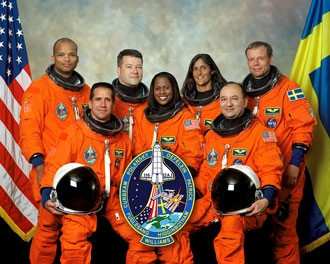
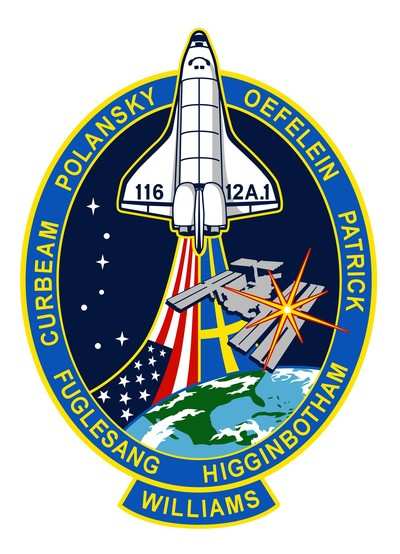
Capt. Robert L. Curbeam Jr. and Cmdrs. William A. Oefelein and
Sunita L. Williams are part of STS-116, a mission that will
continue construction on the station, rewire the orbiting
laboratory and add a segment to its integrated truss structure.
The electrical repairs are the crew’s main mission, but
they also will be rotating a crewmember out of the space station.
Williams will take the place of astronaut Thomas Reiter, and Reiter
will travel back with the shuttle crew.
The ability to perform this part of the mission showcases the
space shuttle’s versatility, due to its large size, Oefelein
said in recent interview.
"I think it just highlights one of the capabilities of the space
shuttle system and one of the capabilities that we’re going
to continue to have with our next-generation space vehicle,"
Oefelein said.
This is Oefelein’s first space flight. An Anchorage, AK
native, he said he became interested in flying at a young age.
Oefelein received his commission from the Navy in 1988 and was
designated a naval aviator in 1990. He was selected by NASA in June
1998 and reported to Johnson Space Center in August 1998. After
completing two years of training and evaluation, he became
qualified for space flight assignment as a pilot. He is assigned as
a pilot on the Discovery mission.
Curbeam, a Baltimore native, says he has always been interested
in spacecraft. While in test pilot school in the Navy, he visited
Johnson Space Center and talked with an astronaut, and that
conversation convinced him to pursue a career with NASA, he
said.
"I started out on this journey not with the goal of being an
astronaut, but with the goal of learning enough about airplanes so
I could go and help design better ones," Curbeam said. "It just so
happened that when I did meet an astronaut and speak with her at
length, it sounded interesting to me. It sounded like something
that I wanted to do. And I was fortunate enough to have pursued
education through enough of my life that I had the qualifications
necessary to be competitive."
Curbeam graduated from the US Naval Academy in 1984 with a
degree in aerospace engineering. He was selected by NASA in 1994
and after a year of training and evaluation, he was assigned to the
computer support branch in the astronaut office. He is a veteran of
two space flights and has logged more than 593 hours in space,
including three spacewalks.
Williams, of Needham, MA, worked in Moscow with the Russian
Space Agency on the Russian contribution to the International Space
Station and with the first expedition crew to the station. She is
currently assigned to the crew of the 14th expedition to the
station, and will join that crew after traveling on Discovery.
"I think just the appeal of people in space and people on the
ground being able to relate to those people in space really makes
people start to wonder, ‘Wow, what else can we do?’"
she said. "So many people in the astronaut office are from
different countries and cultures, and every time someone goes up
that can identify with a group of people on the ground, you get
that group of people wondering, ‘Wow, maybe that could be me
one day.’ There are a million possibilities out there."
Williams received her commission from the US Naval Academy in
1987. She was designated a naval aviator in July 1989 and went on
several deployments as part of a helicopter squadron. She was
selected by NASA in June 1998, and after her training, went to
Moscow to work on the International Space Station. She will serve
as a flight engineer at the station.
Navy astronauts are a major part of NASA’s history, since
America's first manned space flight piloted by Cmdr. Alan B.
Shepard Jr. in 1961.
(Aero-News salutes Army Sgt. Sara Wood, American Forces
Press Service)



 ANN's Daily Aero-Term (04.20.24): Light Gun
 See All